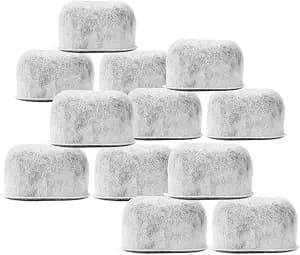
12 Pack Replacement Charcoal Water Filters for All Cuisinart Coffee Machines - Cuisinart Compatible (NOT KEURIG) Filters Fit Both Newer & Older Models Cuisinart Coffee Makers
Description
ENJOY THE DELICIOUS TASTE AND AROMA OF BREWED COFFEE - Removes chlorine, odors, calcium, and other water impurities prior to brewing so you can fully enjoy the delicious taste and aroma of brewed coffee. Replace every 30 days, or more often if you have hard water for best results.; COMPATIBLE WITH CUISINART COFFEE MAKERS – Specially designed for Cuisinart coffeemakers, these set of charcoal filter refills will improve your health by improving the water quality and prolonging the lifespan of your machine.; EASY TO INSTALL – Not only will these filters provide a less expensive way for you to enjoy delicious coffee, but they are also very easy to install. Start enjoying great coffee today by simply using these filters to allow the aroma and fresh-brewed flavors to come through.; FOR USE WITH ALL CUISINART COFFEE MAKERS REQUIRING A FILTER INCLUDING: - Newer model #s DCC-1100, DCC-115O, DCC-1200, DCC-2000, DCC-2200,DCC-2600, DGB-475, DGB 500BK, DGB-550, DGB-600, DGB-700, DGB-900BC Brew Central model #s CBC-00PC2, CBC-00WPC, DC-1200 Grind & Brew model #s DGB-500, DGB-600, DCC-1400, CBC-001, CBC-002, CBC-00BKPC,CBC-SA002 Filter Brew model #s DCC-900, DCC-1000, DCC-1000BK; EACH FILTER MEASURES APPROXIMATELY 1-7/8" x 3/4" x 1 – They meet or exceed original performance standard and are very affordable. Try these high-quality water filters today and you will notice the difference with the first cup.
One less thing to search
Before you buy: quick questions
Are these filters compatible with my specific Cuisinart model, and do they come with a holder?
These are the charcoal disc filters only—they fit directly into the existing water reservoir basket your machine includes. The "works with all models" claim applies to the standard drip coffee makers (like the DCC series). If you have a single-serve or very old model, we recommend checking your manual to confirm the basket shape. Many customers with newer machines (post-2010) have zero issues, but double-checking ensures a perfect fit.
The reviews mention a "papery" smell or taste initially. What's the proper setup?
That's a fair observation you'll see in user videos. To avoid any stale taste, simply rinse the filter under cold water for 10-15 seconds before inserting it. This activates the charcoal and washes away any loose carbon dust. If you skip this step, you might get a temporary "off" flavor in your first brew. It disappears after the first pot, but the rinse is a good habit with any carbon filter, not just this one.
These filters are much cheaper than the Cuisinart brand. Is the quality/build the same?
Users frequently mention cost as the main reason for switching to this multi-pack. In terms of filtration, they perform the same standard charcoal function. The main difference is the physical construction; they can be slightly more rigid than the OEM brand, so you might need to press a little harder to seat them into the holder. They are durable enough for a 60-day cycle, but they aren't "luxury" items—they're practical workhorses for the price.
How long does one filter last, and how do I know when to replace it?
The general recommendation among users is to replace the filter every 60 days, or roughly every two months. Cuisinart suggests changing it more frequently if you have hard water. There is no indicator that tells you when it's depleted—you'll just notice a slight change in the taste of your water. Since this pack gives you 12 filters, it covers you for roughly two years if you stick to a strict 60-day schedule. A tip from users: write the date on the filter with a marker to track it.
If these filters don't fit my machine, how difficult is the return process?
Returns are straightforward through the platform's standard policy—if an item is defective or doesn't fit, you'll typically get a full refund. To avoid the hassle, we've seen users on forums actually measure their filter basket first to compare against the dimensions listed in the product images. If you're unsure, check the Cuisinart model number printed on the base of your coffee maker before ordering to ensure it aligns with the "compatible" list provided in the listing.
From a similar, more-reviewed product in this category: Masticating Juicer Attachment for KitchenAid Stand Mixer
Will this juicer attachment fit my KitchenAid stand mixer?
It's designed to connect to the front power hub found on most KitchenAid tilt-head and bowl-lift stand mixers, so it should click right in for the majority of owners. That said, fit can vary slightly across older or non-US models—many Reddit users recommend double-checking your specific model number against the compatibility info before ordering. If you're unsure, confirm with the seller first; it's the easiest way to avoid a wobbly fit or a return.
Is it really dishwasher safe, or do I have to hand-wash it?
Plan on hand-washing. The listing specifies hand-wash only, and reviewers consistently say the fine filter mesh and auger crevices trap fiber, so a quick rinse-and-brush right after juicing saves you a lot of scrubbing later. The included cleaning brush genuinely helps—TikTok users suggest soaking the mesh in warm water for a few minutes first. It's a small trade-off for an attachment at this price point.
How durable is it, and will the plastic hold up over time?
For light-to-moderate use—a glass or two a few times a week—most owners report it holds up well and feels stable on the mixer. The honest caveat, echoed across reviews, is the plastic drive coupling: a minority of users juicing dense produce like beets or carrots daily have seen it strip or crack over months. If you're a heavy daily juicer, a standalone metal-geared masticating juicer may serve you better; for occasional use, this is a solid space-saving pick.
Does it actually preserve nutrients and give good yield, or is "slow press" just marketing?
The slow-pressure design does a nice job with apples, carrots, cucumber, and celery, delivering smooth juice and reasonable yield for a single serving. Where expectations often outrun reality is with leafy greens and soft fruit—users frequently note the pulp comes out damp and that a second pass helps. So "nutrient-preserving" is fair for the gentle extraction method, but don't expect zero-waste results; pre-cutting large items and accepting slightly wetter pulp keeps expectations realistic.
Who is this best suited for—and when should I consider a dedicated juicer instead?
It shines for casual juicers, small-kitchen dwellers, and KitchenAid owners who love multifunction appliances—people making one or two glasses a week who value a drawer-friendly attachment over a countertop machine. If you juice daily, process large batches, or mainly juice fibrous greens, many reviewers suggest saving for a standalone masticating juicer (Omega and Hurom come up often) for better throughput and easier cleanup. In short: great value for occasional, space-conscious juicing; consider an upgrade if juicing is a daily ritual.
Answers are limited to the manufacturer's listing and the reviews we analysed. Questions those sources cannot support are not answered here.
Transparent by design