Included does not mean verified authentic. Flagged does not mean proven fake. These are analytical classifications.
Showing 3 illustrative excerpts, not the complete review set.
Included in analysis4.0/5 stars
316 Stainless or 316 Stain-lish?
“First off, getting any decent stainless steel at this price is a good deal. These sell for less than what big box stores charge for low-grade mild steel lag screws of the same length (4"). I'd trust these around freshwater, but am not planning to install them at my property on saltwater. The cost difference from known 316 fasteners (what you really need around saltwater) is not great enough to justify the risk. There are 3 red flags, two in the listing itself. First the part's claimed lifetime is "exceeding 3 years." Do you really want to do the job again that soon? Second, in another part of the listing, it is referred to as 321 stainless, which doesn't have the molybdenum content for use around seawater (or other chlorides). I tested the fasteners against known 316 fasteners in an acidic, oxidizing saltwater environment, and found that they pitted much more and dissolved much faster. I attached a photos of (left-to-right) a known 316 lag screw, one that had endured the salt bath, one of these connectors that went through the salt bath, and a virgin one of these connectors. Even after the initial coating was gone, these eroded at more than double the rate of the stamped "316" fastener. The pitting is also much more evident under a loupe. I am treating them as if they're 304 stainless. They're clearly an austenitic stainless steel of some grade, but I'm not using them for a railing by the ocean just to save a few dollars.”
Signals matched: Specific detail: quantity, entity, comparison · Reads as an authentic voice
Included in analysis5.0/5 stars
Really nice swage lags with some so-so extras.
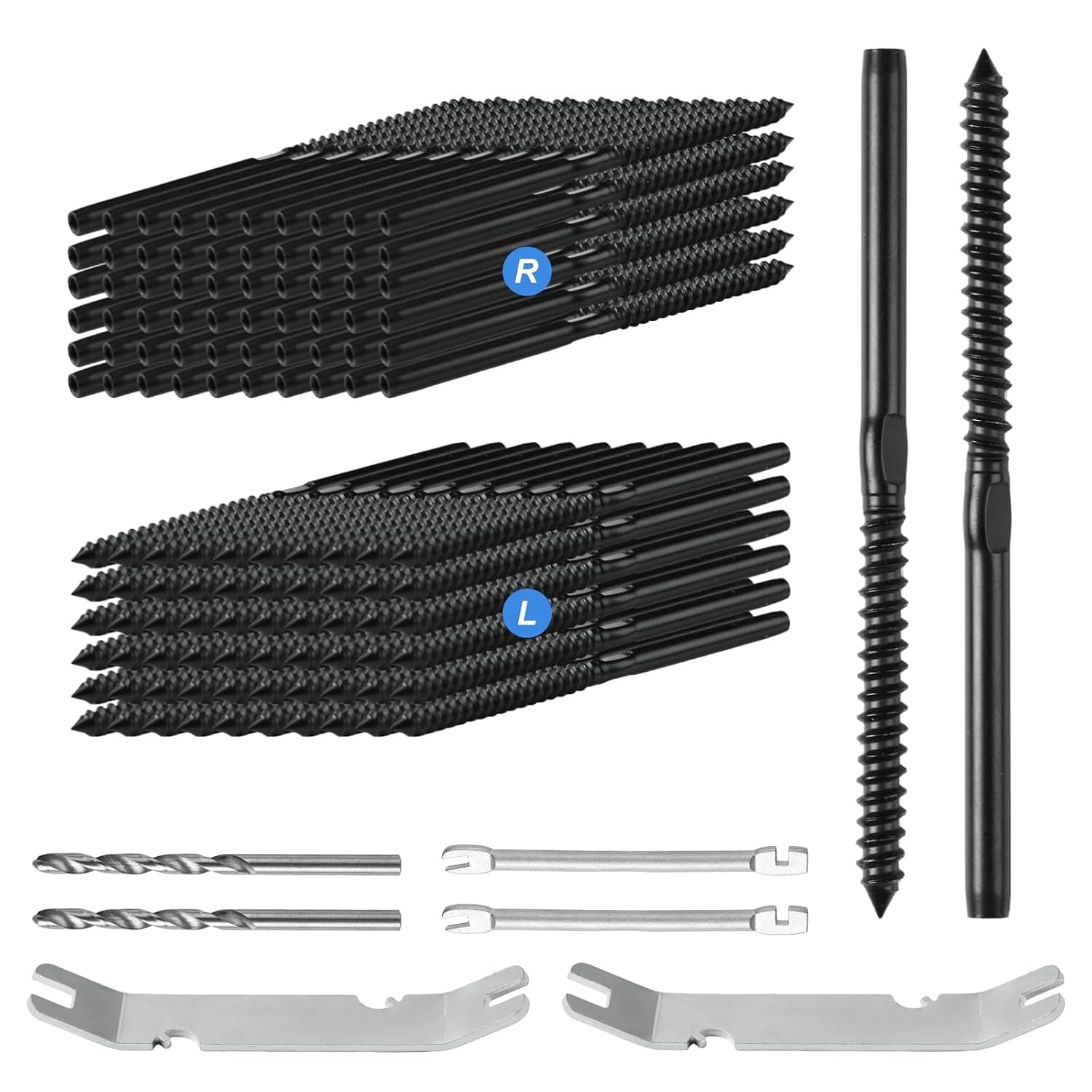
“Nice product. Installation took very little effort. Just measure twice, cut once, and take it slow with predrilling your holes. The product comes with 2x drill bits, 1x of each wrench, and 20x of each Left & Right swage lag. Be aware you will need an official swage tool to crimp 1/8" cable into the lags. Might want to get a heavy duty wire cutter as well, as it ain't no joke trying to cut large cable. The one non-flat wrench they included bent after the very first lag bolt and was useless afterwards. While drilling holes I applied some pressure to one of the drill bits and it bent a complete 90 degrees, so yeah, these extras aren't high quality by any means. The flat wrench served for the entire 11 remaining lags I needed to twist in, and with some lighter pressure the 2nd drill bit drilled the rest of the holes no problem. The lag bolts themselves are built to spec and seem to be very high quality. They are made of very hard material, and the finish on them is really nice. After having them installed for a few days now they are still extremely solid and nothing is loosening up. I fully recommend the product! I'm going to use the rest of them in a treehouse build later this summer.”
Signals matched: Specific detail: quantity, process · Reads as an authentic voice
Included in analysis4.0/5 stars
clever tensioning option for mixed-material installs
“This is a pretty clever take on swage hardware for cable railing. The mix of right- and left-hand threaded lag ends means you can tension the line after it’s already seated, without fighting the twist you normally introduce into the cable. Spin one way, spin the other, and it cancels itself out while pulling everything tight. It’s something you may not even encounter on your install, but it made my setup go a lot easier. I wouldn’t call it a full replacement for the more traditional swage fittings that use set screws or allen tensioners. Those are still the more standardized approach, especially if you’re trying to match existing hardware. Where these shine is in wood posts or mixed-material installs where drilling perfectly straight through isn’t always realistic. Being able to anchor directly and then fine-tune tension without relying on perfect alignment is a bit more forgiving. They’ve ended up fitting into that “use it where it makes sense” category for me. Not a universal solution, but a good option when you need an anchor point into wood or masonry without adding more hardware to the stack.”
Signals matched: Specific detail: entity, process · Reads as an authentic voice