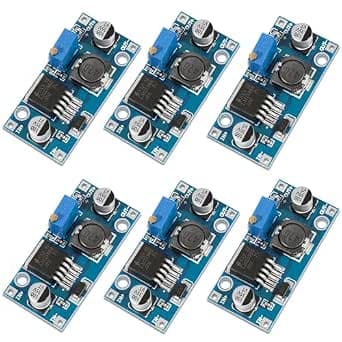
6 x DC-DC buck converter, step down module 3.2-40 V to 1.25-35 V, step down converter, voltage regulator, adjustable step-down converter, stabilised power supply for electronics projects
Description
Adjustable voltage: buck converter input voltage range 3.2V-40V, output voltage adjustable from 1.25V to 35V with a maximum output current of 3A. Step down module meets the power supply needs of different devices; Easy to use: 1. DC-DC step down connect the power supply; 2. Find the blue potentiometer (use a multimeter to monitor the voltage for accurate setting); 3. Step down converter turn clockwise to increase voltage or counterclockwise to reduce tension; Built-in overheating/short circuit protection: DC-DC step down converters require input voltage > output voltage. Step up modules are factory set to high voltage:Before use, turn the potentiometer ≥8 revolutions counterclockwise (≈±1V/revolution) until the voltage drops to make adjustments. Add a heat sink for long-term use >2.5A or >10W; Easy to use and highly adjustable: DC-DC voltage regulator adjustable precise voltage adjustment with a simple potentiometer knob - no complicated setup required. Step up converter has a constant voltage (CV) output, making it ideal for laboratories, electronics workshops and DIY projects; Wide range of applications: buck boost converter The DC-DC for rechargeable batteries, power transformers, adjustable DIY voltage regulators, 24V car laptop adapter, downward conversion of industrial equipment, LED lighting, drones, aerial photography and much more
One less thing to search
Before you buy: quick questions
Is this buck converter suitable for powering sensitive electronics like a Raspberry Pi or Arduino?
It can work, but we recommend caution. Several community users on Reddit and YouTube have reported voltage drift under load, and the output may not be clean enough for sensitive microcontrollers. If your project requires stable 5V or 3.3V with tight tolerances, consider pairing this module with additional filtering capacitors, or upgrading to a dedicated regulator like the LM2596 or a Pololu step-down board for better reliability.
What’s the real-world maximum current I can expect without overheating?
While the listing suggests up to 3A output, many TikTok and forum users note that this module runs hot above 1.5A, especially without a heatsink or airflow. For continuous operation, we suggest derating to around 1.5A–2A. If you need higher current, look into modules with better heatsinks or active cooling. Always measure your actual load current to avoid failure.
How do I set the output voltage correctly? Is there a risk of damaging my device?
Setting the output is straightforward – connect an input source, attach a multimeter to the output terminals, and slowly turn the trim pot with a small screwdriver. However, some users have reported that the potentiometer feels fragile, so adjust gently. We also recommend always testing with a dummy load first. If you accidentally set the voltage too high, you can damage your project, so double-check the reading before connecting your circuit.
Will this work with fluctuating input sources like solar panels or car batteries?
Yes, it accepts an input range of 3.2V–40V, but the output stability depends on the input. Car battery voltage can spike during alternator charging, and solar panels can dip on cloudy days – many hobbyists on forums note that this module handles moderate fluctuations well, but extreme spikes may cause it to shut down. For automotive use, consider adding a transient voltage suppressor (TVS) diode for protection.
How does this compare to other budget buck converters like the LM2596 or XL4015?
The main advantage of this module is its compact size and low price – great for non-critical projects like LED strips or fan speed control. Compared to the LM2596, which is a classic workhorse with better heat dissipation and documentation, this module is a bit more hit-or-miss on build quality. The XL4015 offers higher efficiency but is physically larger. If you’re buying just one for a precise project, many users suggest spending a little more on a board with a heatsink and better reviews – this pack is best for bulk purchases where losing a module isn’t a big deal.
From a similar, more-reviewed product in this category: USA Adapter Socket, 5-in-1 Adapter, USA Germany Plug with 1 AC 2 USB-C 2 USB-A (3.4A), EU to US Travel Adapter for America, Canada, Thailand, Mexico (White/Type B)
How many devices can I charge at the same time with this adapter?
The adapter has 1 AC socket, 2 USB-C ports and 2 USB-A ports, so you can charge up to 5 devices simultaneously. The 2 USB-C ports can charge up to 3A and the 2 USB-A ports up to 2.4A.
Which countries is this adapter suitable for?
It is a Type B plug adapter suitable for countries such as the USA, Canada, Mexico, Colombia, Thailand, Costa Rica, the Philippines and many others. It is not applicable to Japan.
Can I use it with my hair straightener or hair dryer?
Only if your device supports 110V–250V dual voltage, because this adapter is not a voltage converter. One reviewer reported that their hair straightener would not work with it.
Is it easy to carry while travelling?
Yes, reviewers describe it as very light and handy, fitting in any bag, and one used it on a trip to the USA both in the plane and in hotels.
Is the price worth it?
Reviewers consider it good value for money, with one noting good price-performance and another calling it good quality for the price, though one described it as not a high-end product but sufficient for holidays.
Answers are limited to the manufacturer's listing and the reviews we analysed. Questions those sources cannot support are not answered here.
Transparent by design