
Anker SOLIX C300 DC Power Bank Station and 60W Solar Panel, 288Wh Portable Power Station, LiFePO4 Battery, 300W Solar Generator, for Outdoor, Camping, Traveling, and Emergencies
Description
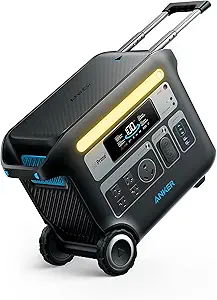
Massive Power on the Go: Take portable power anywhere and deliver 300W and 288Wh to your devices. Fast charge with two 140W two-way USB-C ports.; 7 Device Charging Ports: Power all your tech with versatile ports, including 1× car socket (120W), 2× USB-C (140W), 1× USB-C (100W), 1× USB-C (15W), and 2× USB-A (12W).; Go Anywhere Design: Embrace full portability with a 30% smaller design than similar power stations. Attach the strap (sold separately) for more convenience.; Solar-Powered Escapes: When your journey needs endless charging, do so seamlessly and sustainably with a 60W solar panel. This power station is not compatible with Anker SOLIX PS30 (or other 5V~3A USB-C panels), PS200, PS400.; Your Choice of Recharging: Fast Recharge to 80% in an hour with the dual PD 3.1 USB-C port, or use solar panels or your car. Stay charged, no matter where you are.; 3-Year Power Station Warranty: Your power station is protected with a warranty and quality components, including LiFePO4 batteries, smart temperature control and impact resistance.; What is in the box: Anker SOLIX C300 DC Portable Power Station, 60W Solar Panel, solar to XT-60 charging cable, Extension Cable, 60cm 140W USB-C to C charging cable, safety, and Warranty Card
Compare the trade-offs
Similar products, side by side
A random selection of analyzed products from the same category. Different products are not necessarily interchangeable.

BLUETTI Elite 100 mini Portable Power Station for Camping 1004.8Wh 700W LFP
Anker SOLIX F2000 Portable Power Station, PowerHouse 767, 2400W Solar Generator, GaNPrime Battery Generators for Home Use, LiFePO4 Power Station for Outdoor Camping, and RVs (Solar Panel Optional)

MARBERO Portable Charger Power Bank 48,000mAh Emergency 177.6Wh Portable Power Station, Fast Charging USB-C 60W PD Bright LED Flashlight & Panel for Travel, Camping, Business Trips & Outages
One less thing to search
Before you buy: quick questions
Can the SOLIX C300 power a mini-fridge or CPAP machine at the same time as charging my phone?
The 300W AC output handles most laptops, phones, and cameras with ease, but many TikTok users found that running a mini-fridge (typically 50–150W) plus a CPAP machine can push it close to its limit. If your fridge has a compressor that spikes to 300W startup draw, you risk tripping the overload protection. For heavy-duty simultaneous use, we’d suggest checking the power requirements of each device first, or consider a higher-wattage model.
How fast does the 60W solar panel actually charge the station on a typical camping trip?
In direct, full sunlight, you’ll get roughly 4–5 hours to fully charge the 288Wh battery. However, real-world conditions vary—Reddit users report it can take 6–8 hours in partly cloudy weather or if the panel isn’t angled perfectly at the sun. Many find it works well as a slow top-up during the day, but don’t rely on it for a rapid recharge if you’re using power heavily at night.
Is the unit quiet enough for indoor use during a blackout?
Most owners say the SOLIX C300 is quiet but not silent. The cooling fan kicks on when the AC inverter is active, producing a low hum that some find distracting in a bedroom. If you’re using it in a living room or garage, it’s fine; for a tent or nursery, you might want to place it several feet away. YouTube reviewers suggest keeping it on a soft surface to dampen vibration noise.
What happens if the Anker app won’t pair with my station—is there a workaround?
A small number of users have reported Bluetooth pairing hiccups, but most issues are resolved by updating the app (version 2.3.0+) or resetting the station via the power button. If your unit genuinely won’t connect, Anker support is known for excellent after-sales help; they’ll typically replace or troubleshoot within the 18-month warranty. You can still use all ports without the app, so it’s not a deal-breaker.
Is this better for weekend camping or for emergency home backup?
It’s an ideal middle-ground: portable enough to toss in a car for a weekend trip (it weighs about 8 lbs) and powerful enough to keep a router, phone, and lamp running for 12+ hours during an outage. Vanlifers and RVers who need to run a 12V fridge all weekend love it, while heavy off-grid users sometimes switch to the EcoFlow River 2 for more AC headroom. If your goal is pure home backup with solar, the 60W panel is a handy accessory, but for daily off-grid living, you’ll likely want a larger setup.
From a similar, more-reviewed product in this category: Jackery Explorer 300 Portable Power Station,292Wh
What can the Explorer 300 actually power — and what can't it?
It's built for devices drawing under 300W total: laptops, phones, drones, cameras, fans, lights, a CPAP, and similar electronics. It will *not* run high-draw appliances like coffee makers, toasters, hair dryers, or full-size fridges — those need a larger unit such as the Explorer 1000 v2. A quick tip many reviewers share: check your device's wattage label before buying, and remember the 600W peak only covers brief startup surges, not continuous draw.
How long will it run my device on a single charge?
Use the formula **working time ≈ 292Wh × 0.85 ÷ your device's wattage**. A 60W laptop lasts roughly 4 hours; a 10W phone charge goes for many cycles. Keep in mind real-world runtime varies with temperature and device efficiency — several YouTube testers note heating devices drain it far faster than the math suggests, so plan conservatively for anything that generates heat.
Do I need to buy a solar panel separately, and how fast does it recharge?
Yes — the solar panel is **not included**. Via the 100W USB-C port (wall charger), it fully recharges in about 3 hours; a car port takes around 4 hours. For solar, a 100W Jackery panel reaches 80% in roughly 2.8 hours, while the compact 40W panel takes about 7.5 hours to hit 80%. Many campers recommend springing for the 100W panel upfront rather than the 40W, since the smaller one is best suited to topping up rather than full recharges.
Is it really portable enough for hiking and camping?
At 7.5 lbs with an integrated top handle, it's about 17% lighter than the industry average for its capacity and easy to carry one-handed from car to campsite. That said, TikTok and Reddit users are candid: it's "portable" for car camping, overlanding, and short carries — not for multi-mile backcountry backpacking. If ultralight trekking is your goal, pair it with a small folding panel and treat it as basecamp power rather than pack weight.
How durable is it, and what if something goes wrong after purchase?
The LiFePO4 battery is rated for 4,000+ charge cycles before dropping to 70% capacity — roughly 11+ years of regular use — which is a major step up from older lithium-ion models and a point buyers consistently praise. It operates from 5°F to 113°F. If you receive a defective unit (a small number of buyers report DOA outlets or fan noise), contact Jackery support for warranty service; most report polite resolution, though RMA turnaround can take a couple of weeks. Note that orders require a physical delivery address — PO Boxes aren't accepted — so double-check your shipping details at checkout.
Answers are limited to the manufacturer's listing and the reviews we analysed. Questions those sources cannot support are not answered here.
Transparent by design