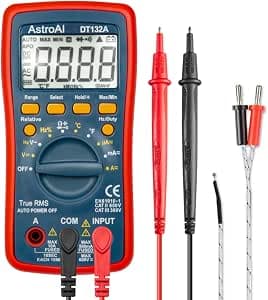
AstroAI Digital Multimeter, Voltmeter Ohmmeter Ammeter with TRMS 4,000 Counts, Manual and Auto Range, Measures Voltage, Current, Resistance, Continuity, Frequency, Diodes, Temperature, Red
Description
【Wide test spectrum:】For AC/DC voltage, AC/DC current, resistance, continuity, capacity, frequency and temperature; tests diodes.; 【Easy to use:】 Practical functions, such as data hold, large LCD display with backlight, kickstand and low battery indicator makes recording and taking of measurements easier than ever.; 【Professional level:】 Features with auto-ranging function and true RMS for measuring AC current and voltage.; 【Safety first:】 Two built-in fuses with a nominal voltage of F500 mA / 600 V and F10 A / 600 V; explosion-proof ceramic fuses provide maximum safety. The fuses can effectively protect the multimeter Overload protection in all areas. ❤ -; 【Ideal for commercial adjustments:】Where the requirements of a long working day are met, from the durable exterior to a wide range of heavy-duty capabilities.
Compare the trade-offs
Similar products, side by side
A random selection of analyzed products from the same category. Different products are not necessarily interchangeable.


One less thing to search
Before you buy: quick questions
Is this multimeter accurate and safe enough for basic automotive diagnostics, like checking a battery or alternator?
Yes, absolutely. With its True RMS accuracy and ability to measure DC voltage up to 600V, it's perfectly suited for common automotive tasks. Many users on automotive forums confirm it works great for checking 12V batteries, testing alternator output, and diagnosing simple circuits. Always remember to follow standard safety procedures when working on a vehicle.
I've heard the included test leads are a weak point. Is that true?
This is a common note in user reviews. While the leads function correctly for most tasks, they are lighter-duty than the meter itself. Users who are rough on tools or need more robust probes often recommend purchasing a separate set of higher-quality, silicone-insulated leads for a few dollars—it’s a popular and worthwhile upgrade for frequent use.
As a complete beginner, will I find this easy to use?
You're exactly who this meter is designed for! The auto-ranging feature is a huge help—it automatically selects the correct measurement scale so you don't have to figure it out. The display is large and clear, and it comes with a well-written manual. YouTube and Reddit are full of hobbyists who started with the AstroAI and found it very approachable.
How does this compare to a super cheap $10 multimeter? Is it worth the extra money?
The difference is significant. Compared to basic models, the AstroAI offers important safety ratings (CAT III 600V), greater accuracy (True RMS), a higher-quality display, and useful extra features like temperature and frequency measurement. Reviewers consistently say the jump in quality, safety, and functionality is well worth the investment for anyone doing more than just checking if a battery is dead.
Is this built for daily professional use on a job site?
This is where expectations matter most. The AstroAI is celebrated as an outstanding *value* meter for home, DIY, and hobby use. However, professionals who commented on social media note that while it performs accurately, the build (especially the plastic battery door/stand) isn't designed to withstand the drops, dust, and rough handling of daily trade work. For that environment, a tool like a Klein Tools or Fluke is the standard.
From a similar, more-reviewed product in this category: USB C Tester Meter USB C 4-30V 0-12A Power Meter Voltage Tester
What can this USB C tester actually measure?
The listing states it measures instantaneous voltage, current, and power, plus maximum voltage, current, and power, charging time, electrical energy, capacity, and instantaneous temperature. It also has a curve display function showing changes over 5, 15, 60, and 120 minute intervals.
How accurate is the meter for high-power charging?
One reviewer found deviations of around 5% at power draw above roughly 75 W, citing examples where a power bank showing 97 W read 92.3 W on the tool and another showing 97.25 W read 93 W. That reviewer described it as a nice gadget but not a precise measuring device.
Is the display easy to read?
Reviewers describe the display as clear and vibrant with nice colours, and one calls the graphical display worth the money. Another notes the display can be flipped 180 degrees, which is helpful.
How do you operate the button?
Per the listing, a single click cycles through the screens, a double-click rotates the displayed content, and holding the button for 3 seconds clears all capacity, electrical quantity, and time. One reviewer notes you have to learn how long to hold the small button on the back.
Does it show which fast charging protocol is being used?
No. The listing states it supports PD2.0/3.0, QC2.0/3.0, FCP, SCP, AFC, PE, DASH VOOC and Super VOOC protocol charging, but the name of the fast charging protocol is not displayed on the tester.
Answers are limited to the manufacturer's listing and the reviews we analysed. Questions those sources cannot support are not answered here.
Transparent by design