Included in analysis5.0/5 stars
Best-sounding, longest-lasting, best-playing, affordable strings for electric guitar
“First off, reviewing guitar strings objectively is extremely difficult. Any new set of strings will generally sound, feel, and play better than any old set of strings. Moreover, changing strings, tuning them, and breaking them in takes enough time that it is practically impossible to get an exact AB comparison across different brands in real-time. You need two otherwise identical guitars with otherwise identical wood, setup, electronics, fret age, etc, and you need to fit them both with new strings of the exact same gauge and type but different brands, in order to really assess the differences between two brands objectively. Which is close to impossible. That said, I personally own four electric guitars, and the studio I work at has about a dozen more. Over the past 15+ years as a musician, sound engineer, and stage hand, I have almost certainly played or recorded well over a hundred. So while I cannot personally swear to have done a scientific head-to-head double-blind test between every brand of strings, I can say a few things pretty categorically. And I have tried a ton of different makes of string, from Ernie Ball to GHS to La Bella to mail-order to store-brand, etc etc. (For bass, I prefer other brands than D'Addario, but that's a seperate review). Sound-wise and playability-wise, these D'Addario Nickel Wounds are great. They have a high-quality, "as-expected" sound for a new guitar string, straight down the middle of how a roundwound nickel string should sound. Longevity is a more-complicated story, and widely misunderstood. First off, here are the things that compromise metal guitar strings, in approximate order or importance: 1. Metal fatigue. Over time, bending and vibrating a piece of metal causes it to become more brittle and to develop microscopic cracks. Tension, stretching, and deformation exacerbate this condition, which is why even coated strings that are never played become dull and dead-sounding after a couple months of sitting on a guitar, compared to an identical set sitting in its package. This wears out strings faster if you play them, but also even if you just leave them sitting on your guitar. In my experience, D'Addario strings are among the best, if not the best, in terms of mainstream commercial guitar strings when it comes to staying supple, soft, and flexible. 2. Surface oxidization/corrosion. This is where coatings can help. Exposure to air, moisture, skin oils, perspiration, etc has a corroding effect on metal strings. Those black, coppery-smelling stripes that you get on your fretting hand are the product of some kind of chemical breakdown in the alloy your strings are made from, releasing certain minerals from the metal onto your fingers. These effects are often over-stated in the marketing materials of coated-strings: they are real, but they are not usually anywhere close to the first thing that kills a set of strings. The conspicuousness of the symptom (black, dull-looking old strings) is often confused with the effects of metal fatigue, and people sometimes think that if they can keep their strings shiny, they will sound and play like new. Not so. Coatings only help the specific problem of surface corrosion, which can be a real one, but is a minor one for most players who keep their guitars in conditioned spaces and who play with clean hands. After a couple weeks of being installed at tension, even coated strings start to succumb to metal fatigue, and need to be changed even if they have never been played or taken out of the case. 3. Physical deformation is the final and most unavoidable symptom. Unless your frets are made of softer metal than your strings (and we should hope that they are not), then playing your guitar inevitably creates "flat spots" on the strings, where they contact the frets. Probably similar at the bridge and nut. These become physical deformities in the string's resonant characteristics, as well as exacerbating metal fatigue and compromising surface integrity at those points, affecting both of the above. Taking all of the above into consideration, and assuming that you want soft, supple nickel strings that won't chew up your frets, I think these are your best overall choice. My one exception might be if you have serious problems related to surface corrosion, due to bodily PH imbalances or outdoor gigs, etc, in which case you might benefit from coated strings. But for most players, the strings are going to wear out from metal fatigue long before corrosion has a real effect on the sound or playability.”
Signals matched: Specific detail: process, comparison · Mentions: sound quality, tone, durability · Reads as an authentic voice
Included in analysis5.0/5 stars
His go-to strings — every new guitar gets these first
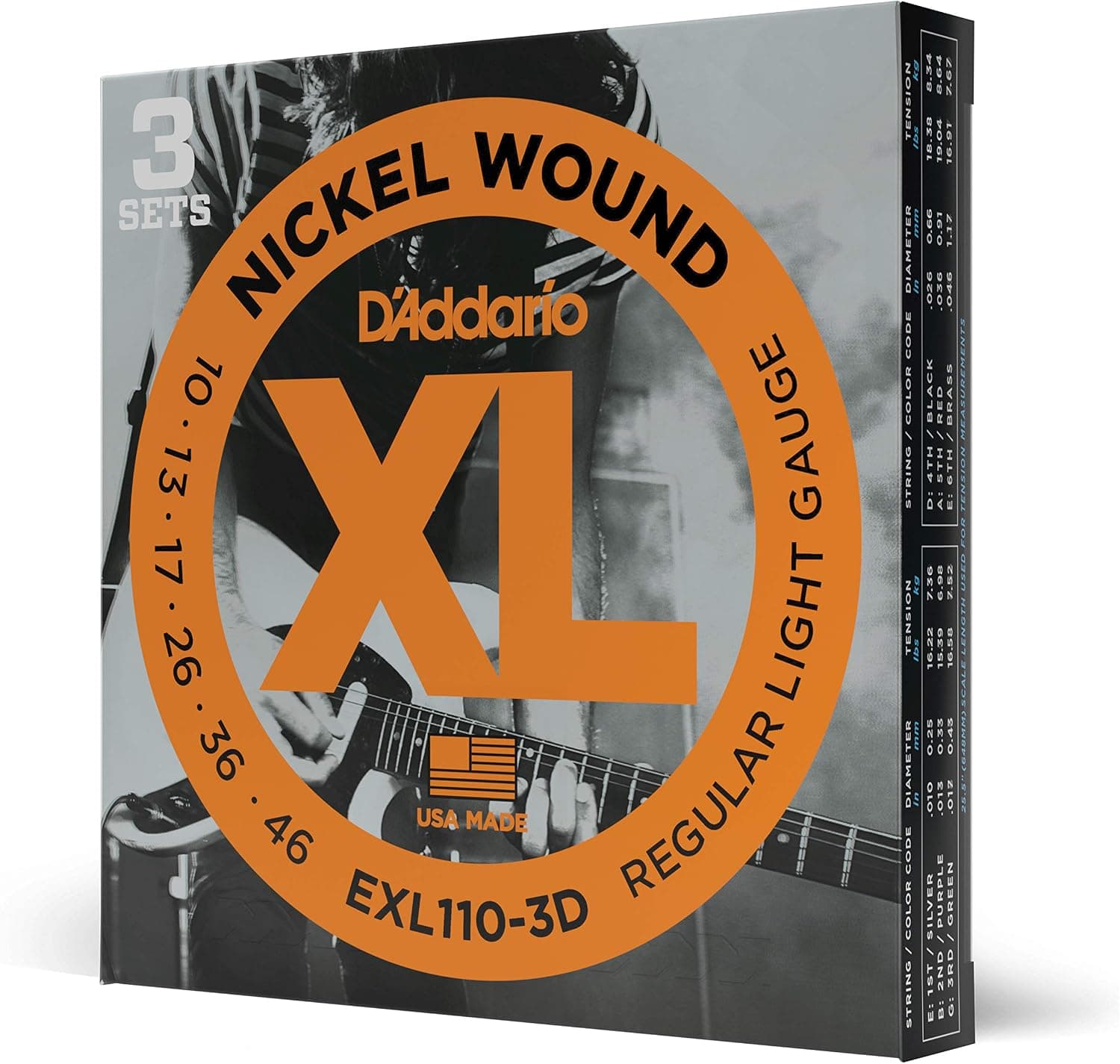
“no matter which one he picks up, these are the strings he trusts. Every time he gets a new guitar, restringing it with these is the first thing he does. The 10-46 gauge is a great all-around choice — comfortable for chords and rhythm playing while still holding up fine for bending on lead lines. Tone-wise, they're bright and punchy right out of the pack, with that classic nickel-wound clarity that cuts through a mix well. Intonation has been spot-on, no fighting with tuning stability after the initial stretch-in period. Durability is solid too — they hold their tone for a good while before sounding dull, which matters when you're restringing as often as he does. Getting three sets in one pack is perfect for him since he's never without a fresh set when the next guitar comes home. Pros: Bright, consistent tone; accurate intonation; durable; comfortable gauge for chords and leads; great value with 3 sets included; a proven favorite across many guitars.”
Signals matched: Specific detail: quantity, entity, process · Mentions: tone, string quality · Reads as an authentic voice
Included in analysis5.0/5 stars
Reliable, Long-Lasting Guitar Strings That Hit Every Note
“I bought these guitar strings for my husband, and they’ve exceeded our expectations. He plays regularly, and these strings offer a perfect balance of tone, feel, and durability. The nickel winding gives a smooth, consistent feel across all frets, and the sound is bright without being harsh, making it. perfect for both rhythm and lead playing. What makes these sets stand out compared to others we’ve tried is their reliability and consistency. Every set in the box felt exactly the same as the last, which is a huge plus if you restring frequently. They also hold tuning well, even with heavy strumming or bending notes, and resist corrosion better than other strings we’ve used. For anyone looking for high-quality, long-lasting strings at a reasonable price, this 10-pack is a smart buy. My husband’s guitar sounds incredible, and he’s thrilled to have plenty of sets on hand. Definitely a purchase we’d make again.”
Signals matched: Specific detail: entity, comparison · Mentions: tone, durability, consistency, sound quality · Reads as an authentic voice