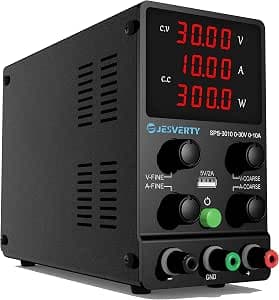
DC Power Supply Variable, 30V 10A Adjustable Switching Regulated DC Bench Power Supply with High Precision 4-Digits LED Display, 5V/2A USB Port, Coarse and Fine Adjustments AC240V Jesverty SPS-3010
Description
1️⃣【4-Digit Display & Power Calculation】: Jesverty bench power supply features a big bright 4-digit LED display that shows measured values of V/A/W that the unit outputs in real-time. The display resolution is up to 0.01V, 0.001A, and 0.1W.; 2️⃣【Auto C.V. and C.C. Mode】: Jesverty variable power supply can be used as a constant-voltage*(C.V.) power supply and constant-current*(C.C.) power supply even when the load is changed. It switches automatically between CV mode and CC mode according to the changes in the load.; 🌟Note: The V and A settings you set are the crossover point at which the mode switches.; 3️⃣【Compact Body & Lightweight】: Jesverty DC power supply variable measures only 7.1(D)x3.35(W)x6.1(H)inches and weight of approx. 1.2kg. It saves space on your workbench and can be moved around without any frustration.; 4️⃣【Reliability and Safety】: Jesverty benchtop power supply is built with high-quality materials and reliable circuit designs that include multiple protection functions, such as short-circuit protection, over-load protection, grounding terminal, temperature-regulated fan, etc. to ensure performance and extend the lifespan.; 5️⃣【Items you get & Customer service】: 1 x SPS Unit, 1 x Power Cord*, 1 set of test leads*, 1 x instruction manual (contact information included). We provide professional technical support. Should you have any problems or questions about your order, please feel free to contact the Jesverty Customer Service via Amazon or email.; 🌟Note: Power cords and the AC input settings vary depending on the destination for the product at the factory-shipment.; 🌟Note: The test leads that come with the unit are merely a give-away, we recommend that you prepare test leads with sufficient current capacity if your project needs long-term use of high current.
One less thing to search
Before you buy: quick questions
Is the main adjustment knob really as sensitive as some YouTube reviewers say?
Many users note the coarse voltage/current knob is quite sensitive, which can make setting a precise value (like 3.3V) tricky at first. The unit includes a separate "Fine" adjustment knob specifically to compensate for this. With practice—using the coarse knob to get close and the fine knob to dial it in—achieving precise settings becomes much easier.
How loud is the cooling fan, and when does it turn on?
The cooling fan is a common point of discussion. It is audible and tends to turn on based on temperature, not just load, which can sometimes seem random. While not silent, most hobbyists find it acceptable for a home bench. If you need a near-silent workspace for audio work, you might want to consider a linear power supply, though they are larger and more expensive.
Is this power supply suitable for a complete beginner in electronics?
Absolutely. It's a very popular choice for students and beginners due to its clear display, straightforward controls, and protective features like over-current protection (OCP). While the manual isn't the best, there are numerous clear setup tutorials online. The excellent value lets you learn on capable hardware without a huge investment.
What's the build quality like, and how durable is it?
The build is best described as "good for the price." It's a compact, lightweight switching supply with a plastic front panel. The binding posts and knobs work reliably but may not feel as heavy-duty as equipment costing three times as much. For typical hobbyist use—prototyping, testing circuits, charging batteries—it is perfectly durable and stable.
Can the USB port be used as a controlled 5V output, or is it just for charging?
The 5V/2A USB port is a dedicated charging port and is not controlled or displayed by the main unit. It's a convenient bonus for powering a Raspberry Pi, Arduino, or charging a phone independently while you use the main outputs for your project. For a controlled 5V source, you would use the main output channels.
Answers are limited to the manufacturer's listing and the reviews we analysed. Questions those sources cannot support are not answered here.
Transparent by design