What people like
Fast charging and quiet operation
Several reviewers report fast AC charging and very quiet operation, including one who charged from 80% to 100% in 15–20 minutes at a park outlet.
Our buying verdict
Several reviewers praise fast charging and quiet power delivery, but charging glitches, odors, and failures recur.
Buyers who mainly need fast AC recharging and quiet power for high-draw devices like RV AC, DJ gear, or drone batteries in short-term use.
Buyers who plan to rely on solar or DC charging, or who need dependable long-term emergency backup without firmware or port failures.
The 30-second read
What people like
Several reviewers report fast AC charging and very quiet operation, including one who charged from 80% to 100% in 15–20 minutes at a park outlet.
The main watch-out
Several reviewers say charging from DC or solar requires additional DJI modules and adapter cables, and some report those accessories are unavailable or hard to find.
Before you choose
Several reviewers note the unit is heavy, though some say it is still manageable to lift; consider whether you will move it often.
From a similar, more-reviewed product in this category: Jackery Explorer 300 Portable Power Station,292Wh
What people like
Several reviewers use it to charge phones, laptops, and CPAP machines, and value it as backup power during outages. It is described as compact, lightweight, and easy to carry.
The main watch-out
Several reviewers report fast battery drain, short runtimes, or units that stopped working, including some that failed after limited use. Others report charging problems or overheating.
Before you choose
Reviewers using it for CPAP report very different runtimes depending on humidifier and heated-hose use; some got only about four hours, while others got a full night with those features off.
High-volume review analysis
Five signals are scored from the collected reviews; every line shows the statistic that produced it.
Signals run from −1 to +1. See Methodology for what this analysis cannot detect.
Description
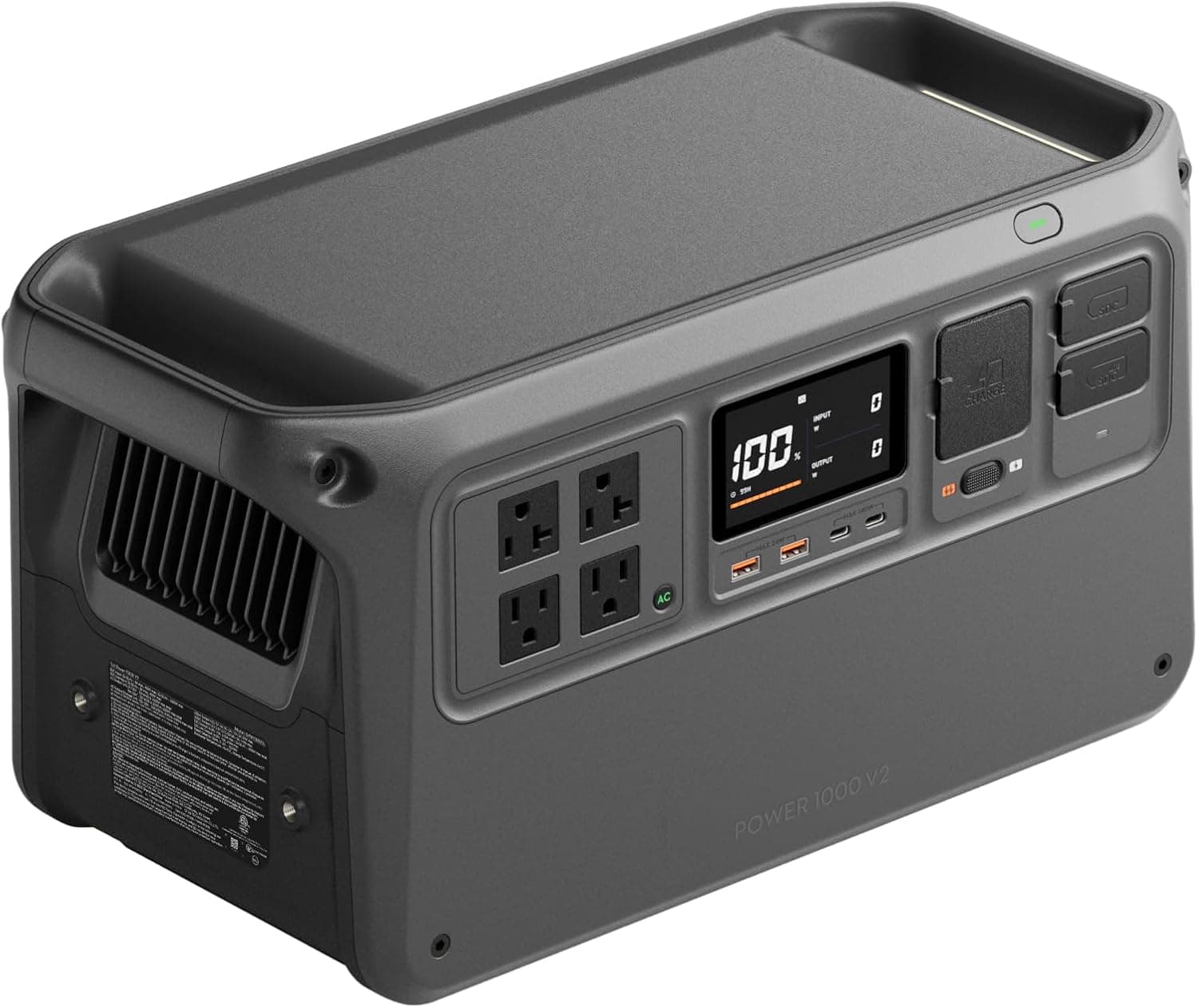
Product description DJI Power 1000 V2 1024Wh Portable Power Station Previous page Next page 1 2600W Output 2 Flexible Fast Recharging 3 Multiple Ports 4 Ultra-Quiet Previous page Next page 1 Protection Upgrade 2 LiFePO4 Battery Cell 3 BMS 4 Hardware Design 5 Globally Certified Previous page Next page 1 Home Backup 2 Camping and Road Trips 3 Content Creation 4 Home Projects & DIY Previous page Next page 1 UPS Mode 2 DJI Drone Fast Charge 3 Smart App Control 4 Extensive Accessories Discover More About DJI Power 1000 V2 Previous page Next page Which is the Best for You? DJI Power 1000 V2 Add to Cart DJI Power 1000 V2+100W Buying Options DJI Power 1000 V2+200W Add to Cart DJI Power 1000 Buying Options DJI Power 2000 Add to Cart Customer Reviews 4.3 out of 5 stars 1,214 — 4.5 out of 5 stars 42 4.3 out of 5 stars 1,214 4.4 out of 5 stars 830 Price $469.99$469.99 — $1,177.00$1,177.00 — $749.99$749.99 Capacity 1024 Wh 1024 Wh 1024 Wh 1024 Wh 2048 Wh Max Continuous Output 2600 W 2600 W 2600 W 2200 W 3000 W Net Weight Approx. 31.3 lbs (14.2 kg) Approx. 31.3 lbs (14.2 kg) Approx. 31.3 lbs (14.2 kg) Approx. 28.6 lbs (13 kg) Approx. 48.5 lbs (22 kg) Dimensions 17.6x 8.8 x 9 inches (L×W×H) 17.6x 8.8 x 9 inches (L×W×H) 17.6x 8.8 x 9 inches (L×W×H) 17.6×8.8×9 inches (L×W×H) 17.6×8.8×12.7 inches (L×W×H) Cell Chemistry LFP (lithium ferrophosphate) LFP (lithium ferrophosphate) LFP (lithium ferrophosphate) LFP (lithium ferrophosphate) LFP (lithium ferrophosphate) Typical Cycle Life 4000 Cycles 4000 Cycles 4000 Cycles 4000 Cycles 4000 Cycles Recharge to 100% 56 mins 56 mins 56 mins 70 mins 90 mins Output Ports 10 10 10 8 14 USB-C Max Output Power 140 W 140 W 140 W 140 W 140 W Max Operating Altitude 5000 m 5000 m 5000 m 3000 m 5000 m
Compare the trade-offs
A random selection of analyzed products from the same category. Different products are not necessarily interchangeable.

MARBERO Portable Charger Power Bank 48,000mAh Emergency 177.6Wh Portable Power Station, Fast Charging USB-C 60W PD Bright LED Flashlight & Panel for Travel, Camping, Business Trips & Outages

AFERIY P210S 2048Wh Portable Power Station 2400W(4800W Peak)Solar Generator

Takki 88.8Wh Portable Power Station Lithium Battery Small Generator Power Bank with 110V AC Outlet Battery Backup for Camping Home Use Emergency(Solar Panel Optional)
Check the evidence
Included does not mean verified authentic. Flagged does not mean proven fake. These are analytical classifications.
Showing 3 illustrative excerpts, not the complete review set.
DJI Power 2000 Failed After Only 3 Weeks
“DJI Power 2000 Failed After Only 3 Weeks — Nearly 7 Weeks Dealing With Support and Still No Repair Case I’m extremely disappointed with both my DJI Power 2000 and the customer support I’ve received from DJI. I purchased the Power 2000 at the beginning of a 6-month trip, expecting it to be a reliable source of portable power. I spent a significant amount of hard-earned money on this unit, and it started having major problems after only about 3 weeks of use. The problem is severe. The unit will show around 85% battery remaining and then suddenly die completely. When I plug it back in, it behaves as though the battery is at 0% and charges all the way back to 100%. I essentially have a power station that I cannot trust because I never know when it is going to shut down. I first contacted DJI Support on August 17, 2026. Since then, I have exchanged multiple emails with support and followed the troubleshooting steps they provided, including firmware updates, slow charging, allowing the unit to rest for 24 hours, and retesting it. The problem continued. Eventually, DJI told me to create a repair case. That created an entirely new problem. When I select my DJI Power 2000 through DJI’s repair system, the website tells me that because of the characteristics of the product, I need to contact DJI Support for assistance and a timely replacement. The only option is “Contact Now,” which sends me right back to DJI Support. I explained this to DJI multiple times. I refreshed the page and attempted the process again exactly as instructed. Same result. On September 16, DJI Support stopped responding to my emails. I followed up again, clearly explaining that their own repair system would not allow me to create a case and asking them to manually create or escalate a repair/replacement case. Still nothing. It is now October 2, 2026. I originally contacted DJI on August 17, and after nearly 7 weeks, I STILL do not have a repair case number, return instructions, replacement, or resolution. That is unacceptable customer service for an expensive product that failed after only a few weeks. I bought this unit specifically because I was traveling for six months and needed something dependable. Instead, I have spent a large portion of my trip dealing with troubleshooting, emails, a repair website that sends me in circles, and unanswered follow-ups. Meanwhile, I’m stuck with an expensive Power 2000 that I cannot depend on. I understand that electronics can occasionally fail. What is most disappointing is how DJI has handled the failure. A defective product can be repaired or replaced. Leaving a customer without a working product, without a repair case, and without even responding to their emails is a customer-service problem. I have documentation of my correspondence with DJI Support going back to August 17 and the attempts I have made to get this resolved. I really wanted to like the DJI Power 2000, but based on my experience, I cannot recommend spending this kind of money on one. My unit developed a serious battery/power-management problem after approximately three weeks, and nearly seven weeks after first contacting support, I still don't have a repair or replacement case. Buyer beware: if your Power 2000 develops a problem like mine did, my experience shows that getting it repaired or replaced may be far more difficult than you would expect. DJI, if you see this review, I am simply asking for what I have been requesting for weeks: create my repair/replacement case, provide me with a case number and shipping instructions, and resolve the problem.”
Signals matched: Specific detail: entity, quantity, process · Reads as an authentic voice
Great Dji power backup
“⚙️ Specs & Performance Highlights • Capacity & Output: 2,048 Wh LiFePO₄ battery with 3,000 W continuous (4,000 W peak) output—enough to run most household or marine loads reliably  . • Recharging Speed: Charges from 0 to 80% in 55 minutes and full in ~90 minutes using AC power. It can also support up to 1,800 W solar input or up to 1,000 W via car/RV charging (with accessories) . • UPS Mode: Offers automatic switching within ~0.01 seconds to protect sensitive electronics—ideal if you’re providing backup power for radar, navigation, or communication systems . ⸻ 🛠️ Built for Durability & Quiet Operation • Operates at under 30 dB, quieter than a typical refrigerator—especially useful to avoid disturbing guests or crew aboard . • Constructed with flame‑retardant materials, sub‑nano coated electronics, 26 temperature sensors, and 21 fuses to ensure safety in harsh marine environments—including salt spray and humidity . • Physically rugged—designed to withstand up to one ton of static pressure—suitable for rough boat handling or transit . ⸻ 🔌 Port Layout & Connectivity • Offers 4 AC outlets, 4 USB‑C ports (two rated at 140 W), and 4 USB‑A ports—can simultaneously power multiple devices like charging stations, laptops, and drones . • Includes SDC ports designed for DJI drone charging or expansion batteries—though optional accessories are required. • Limited onboard wheels but offers a compatible hand trolley for easier movement on deck or dockside  . ⸻ ⚓ On the Boat: Use Cases & Benefits • Generator Depth Relief: Perfect for shifting tasks from noisy generators to quiet, clean battery power—especially useful in marina slips or when operating sensors, refrigerators, or laptops. • Short Backup Runs: With average usage of ~2 kW, it can sustain power for ~1 hour and be quickly recharged between excursions—especially beneficial during high-demand periods. • Compatibility with Solar: Mount portable solar panels on deck between trips to top up charge while at anchor (though solar input speeds depend on panel size/accessories). ⸻ ✅ What to Love & a Few Caveats Pros: • Excellent power-to-size ratio and rapid recharge time • Ultra-quiet and very rugged build • Advanced safety with long 4,000-cycle lifespan (~10 years) at 80% capacity . Cons: • Requires the DJI Home app to access some advanced charging modes, which some users find poorly optimized . • SDC accessories and proprietary connectors can feel cumbersome compared to standard XT60/MC4 systems . • Handling can be awkward aboard—no built-in wheels, though you can add the optional trolley accessory . ⸻ 💰 Pricing & Value for a Sale Deal • Launch price on DJI’s site and Amazon has been $1,299 USD, with occasional promotions under that. It represents strong value at that level considering build quality, output, and brand support  . • If you’ve spotted it on sale (especially under $1,200), you’re getting excellent hardware at a bargain compared to similarly spec’ed EcoFlow or Jackery units.”
Signals matched: Specific detail: entity, quantity, process · Reads as an authentic voice
Power Station “bricked” on required firmware update
“UPDATED: Seller replaced our original item after MUCH DELAY and back and forth. We charged the new unit to full power, but when our power went out and we tried to use it, none of the AC ports supplied any power. Just like the previous unit, this UNIT IS BRICKED. We haven’t touched it since we charged it and left it on standby for emergencies. MAJOR FAIL, and I assume it will be the usual nightmare with this seller, trying to get a refund. ORIGINAL REVIEW: Very disappointed with this company. We were really excited about the specs and price of this power station. Upon setup and initial charge, everything seemed to go smoothly. All they provide is a small folding page of confusing diagrams—a quick set-up guide?—presumably telling you what the various ports are for? They are pretty obtuse, and there is no verbal explanation. However, we downloaded the DJI app as recommended and set up Bluetooth and Wi-if. At that point the app says “…there is an update to the firmware that addresses known issues.” With instruction to just click through and the firmware update will be applied. Unfortunately during the upload, that froze the power station and it never moved forward and couldn’t be turned off. Just basically “bricked” the unit. We spent 10 days going back and forth with the seller trying to find a way to reset the unit. Their support was useless, so I turned to Gemini, who provided more options, including several ways to force a reset—unfortunately none of them worked. During this entire time, I was in communication with customer support, who seems to not be fully fluent in English, because they just kept giving me the same useless instructions, reworded different ways. (Each communication took another 24 hours). In the end we decided to replace the unit. After multiple fiascos with the returns department, (another lost 3 days) I was finally able to arrange a pickup (this unit weighs 50 pounds). MOST IMPORTANT: During the return process I repeatedly requested they either locate a unit with the current firmware, or UPGRADE IT BEFORE SHIPPING IT. I thought they were dealing with us in good faith, but obviously they were just saying what they needed to say to save the sale. We have the new unit now, tried setting it up and got the message that the firmware needs to be upgraded “to address known issues!” So where to go from here? Do we “brick” another unit? Go through another 2 weeks trying to get the unit shipped back? Not sure, but I RECOMMEND YOU AVOID THIS PURCHASE and and save yourself a world of inconvenience.”
Signals matched: Specific detail: process, scenario · Reads as an authentic voice
One less thing to search
With 2600W continuous output, it handles the vast majority of household and outdoor gear — kettles, projectors, saws, drills, and most full-size fridges (check your appliance's startup surge). One honest caveat many campers raise: at roughly 31 lbs, it's better described as "transportable" than "carry-it-up-a-trail portable." It shines in RVs, car trunks, job sites, and home backup — not backpacking.
Yes — and this is the most common pre-purchase surprise. The MPPT and car charging modules are **not built in**, so charging from a solar panel or car battery requires a separate compatible DJI adapter. If off-grid solar is central to your plan, budget for that adapter up front. AC wall charging, however, works right out of the box with the included cable.
In real-world use, most owners confirm the fast-charge hype — a full AC recharge takes about 56 minutes under ideal conditions, and the "coffee-break top-up" is a genuine highlight in reviews. Just know that hitting peak speed depends on your circuit and outlet, and fast charging does produce some fan noise and warmth. It's impressively quick, but "ideal conditions" is the fine print.
This is where it wins over van-lifers and RVers — operation drops as low as 26 dB, quiet enough for enclosed nighttime use. The 1024Wh LFP battery is rated for roughly 4000 cycles (about a 10-year lifespan), backed by up to a 5-year warranty. For context, LFP chemistry is the safer, longer-lasting standard, and DJI pairs it with an intelligent BMS and flame-retardant housing.
If you're in the DJI ecosystem, the fast drone charging, dual 140W USB-C ports, and 10ms UPS mode make it a strong, well-built pick — creators and home-office users especially praise it. Compared to legacy brands like EcoFlow or Jackery, DJI is newer to power stations, so some Reddit users rightly flag fewer service centers and question long-term category commitment. The 5-year warranty helps offset that, but if built-in solar and a longer track record matter most, compare the EcoFlow Delta 2 or Bluetti AC180 before deciding.
From a similar, more-reviewed product in this category: Jackery Explorer 300 Portable Power Station,292Wh
It's built for devices drawing under 300W total: laptops, phones, drones, cameras, fans, lights, a CPAP, and similar electronics. It will *not* run high-draw appliances like coffee makers, toasters, hair dryers, or full-size fridges — those need a larger unit such as the Explorer 1000 v2. A quick tip many reviewers share: check your device's wattage label before buying, and remember the 600W peak only covers brief startup surges, not continuous draw.
Use the formula **working time ≈ 292Wh × 0.85 ÷ your device's wattage**. A 60W laptop lasts roughly 4 hours; a 10W phone charge goes for many cycles. Keep in mind real-world runtime varies with temperature and device efficiency — several YouTube testers note heating devices drain it far faster than the math suggests, so plan conservatively for anything that generates heat.
Yes — the solar panel is **not included**. Via the 100W USB-C port (wall charger), it fully recharges in about 3 hours; a car port takes around 4 hours. For solar, a 100W Jackery panel reaches 80% in roughly 2.8 hours, while the compact 40W panel takes about 7.5 hours to hit 80%. Many campers recommend springing for the 100W panel upfront rather than the 40W, since the smaller one is best suited to topping up rather than full recharges.
At 7.5 lbs with an integrated top handle, it's about 17% lighter than the industry average for its capacity and easy to carry one-handed from car to campsite. That said, TikTok and Reddit users are candid: it's "portable" for car camping, overlanding, and short carries — not for multi-mile backcountry backpacking. If ultralight trekking is your goal, pair it with a small folding panel and treat it as basecamp power rather than pack weight.
The LiFePO4 battery is rated for 4,000+ charge cycles before dropping to 70% capacity — roughly 11+ years of regular use — which is a major step up from older lithium-ion models and a point buyers consistently praise. It operates from 5°F to 113°F. If you receive a defective unit (a small number of buyers report DOA outlets or fan noise), contact Jackery support for warranty service; most report polite resolution, though RMA turnaround can take a couple of weeks. Note that orders require a physical delivery address — PO Boxes aren't accepted — so double-check your shipping details at checkout.
Answers are limited to the manufacturer's listing and the reviews we analysed. Questions those sources cannot support are not answered here.