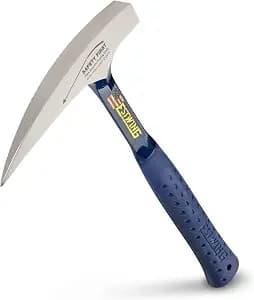
ESTWING Rock Pick - 22 oz USA Made Geology Hammer with Pointed Tip & Shock Reduction Grip - E3-22P
Description
Product Description Estwing Rock Picks are the #1 choice of geologist and paleontologists worldwide. These American made striking tools are fully forged in one piece making them the strongest, longest lasting geological tools available. This rock pick features our patented Shock Reduction Grip the most comfortable, durable grip on the market. The Shock Reduction Grip reduces impact vibration by over 70%. It is molded and bonded directly to the tools steel core, meaning it will never slip, even under the harshest conditions. Estwing striking tools are proudly made in Rockford, IL. From the Manufacturer Estwing E3-22P 22-Ounce Rock Pick
One less thing to search
Before you buy: quick questions
Is this rock pick too heavy for all-day fieldwork?
Many users love the 22 oz weight for its solid striking power, but Reddit threads and TikTok reviewers note it can tire your arm during long sessions—especially if you’re chiseling for hours. If you’re a casual weekend rockhound, the weight feels balanced and effective. For professional geologists doing full-day work, some recommend the lighter 14 oz version for better endurance without sacrificing too much force.
How does the pointed tip hold up on very hard rocks like granite or quartz?
The forged steel tip is incredibly tough, but a handful of YouTube reviewers report it can dull faster than expected on extremely hard stone. The good news: Estwing’s one-piece construction means the tip is integral to the head, so it won’t break off. You can re-sharpen it with a file or grinder when needed—a common practice among experienced geologists.
Does the shock reduction grip actually make a difference?
Yes, the blue shock reduction grip significantly cuts vibration compared to traditional wooden or plain steel handles. Many TikTok users say it prevents hand fatigue during repetitive hammering. However, a few reviewers note the grip can become slippery when wet or covered in dust—so cleaning and drying it after use keeps performance consistent.
Can I use this for concrete, masonry, or demolition?
While the Estwing rock pick is designed for geology and fossil work, many DIYers have used it on brick and softer concrete. It’s not recommended for heavy demolition on reinforced concrete—the pointed tip is meant for precise chipping, not repeated brute force. For serious masonry work, consider the Estwing chisel-end hammer or a dedicated sledgehammer.
Is this better than the Estwing chisel-edge rock hammer (E3-22P)?
It depends on your task. The pointed tip (E3-22PC) excels at prying fossils, breaking small samples, and detailed work. The chisel edge (E3-22P) is better for splitting rocks along seams and larger-scale cracking. Some serious collectors on Reddit own both, but if you mostly split rocks in half, the chisel version gets more enthusiastic praise. For delicate extraction and pinpoint strikes, this pointed pick wins.
From a similar, more-reviewed product in this category: IGAN-330 Flush Cutters, Precision Wire Cutter, Flush Pliers, Wire Snips, Electrical Cutters, Sprue, Side & Small Wire Nippers, Diagonal Cut Snips, Ideal for Electronics & Precision Cutting Needs
What materials can these flush cutters cut?
The listing says they handle soft wire up to 14 AWG, including copper wire 14 AWG (Φ1.6mm) and iron wire 14 AWG (Φ1.6mm), and are not for use on steel wire. Reviewers report using them successfully on small wires, plastic sprues, zip ties, 3D printed parts, and the plastic portion of Cat 6A cabling.
Are the blades sharp enough for clean, flush cuts?
Reviewers describe the blades as super sharp and able to give a clean, flush cut without crushing or bending the material, with one noting they cut a laser sharp line through paper, thin foils, and solid core wire. One reviewer noted the tips are not as sharp and pointed as pictured.
Are these cutters comfortable to use for longer sessions?
Reviewers say they are lightweight without feeling flimsy and that the grip is comfortable enough for longer sessions. The listing states the ergonomically designed non-slip rubber handle provides comfort and control and reduces hand fatigue, with a spring-loaded mechanism to minimize fatigue from repetitive motion.
How durable are these cutters?
The listing states they are forged from heat-treated chrome vanadium steel with a Rockwell hardness of 60C and a 12-month warranty. One reviewer reported rusting and sharp outer edges after three days in a desk drawer, while another used them on small steel die sprues despite the steel-wire restriction.
What are these cutters best suited for?
The listing says they are ideal for models, sprues, electronics, jewelry making, and zip ties, and are sized for working in small spaces. Reviewers report using them for trimming small wires and plastic sprues, electronics, zip ties, 3D printed parts, GUNPLA or plastic minis, modeling, and Cat 6A cabling.
Answers are limited to the manufacturer's listing and the reviews we analysed. Questions those sources cannot support are not answered here.
Transparent by design