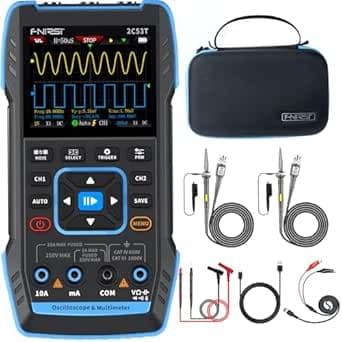
FNIRSI 2C53T Upgraded Handheld Oscilloscope, 50MHz Bandwidth, 3IN1 Digital Oscilloscope Multimeter DDS Generator, 250MS/s Sampling Rate, 19999 Counts, Voltage, Current, Capacitor, Resistor, Diode Test
Description
【Newly Version】The 2C53T is an upgraded version of the 2C23T, which improves the measuring range and adds math operation,cursor measurement,persistence mode,XY mode features; 【2 Channel Oscilloscope】50 MHz bandwidth, 250 MSa/s sampling rate, 1 Kpts record depth, automatic measurement function, max voltage 400 V, vertical sensitivity 10mV/div-10V/div , support waveform image storage and export; 【4.5-Digit 19999 Counts Multimeter】AC Voltage: 0-750 V, DC Voltage: 0-999.9 V, DC/AC Current: 0-9.999 A, Resistance: 0-19.99 MΩ, Capacitance: 0-99.99 mF, Continuity Measurement. Multi-function meter for professionals, schools and hobbyists; 【Signal Generator】The maximum waveform output frequency can reach 50 kHz and a step of 1 Hz, and can output 13 waveforms; 【Save function】one-click save, screening function. You can upload the saved image by connecting to PC via Type-C. You can easily compare the waveforms by displaying the reference waveform and the measured waveform on the same screen; 【Excellent Design】The Oscilloscope adopts FPGA+MCU+ADC hardware architecture, built-in high-voltage protection module, adopts 2.8 inch LCD display, built-in 3000 mAh battery, standby time up to 6 H, Type-C interface supports 5 V/1 A charging; 【Language Switch】After powering on the device, press the left or right directional buttons to enter System Settings, then select the Language option to switch languages.; 【Firmware Installation】 Connect the device to the computer via a data cable. Press and hold the MENU button, then press the Power button to enter firmware installation mode. Copy the firmware to the popped-up USB drive on the computer.
One less thing to search
Before you buy: quick questions
I'm new to oscilloscopes. Is the FNIRSI 2C53T too complicated for a beginner?
It's a popular "first scope" for hobbyists, but there is a learning curve. The device packs advanced features, but the included manual is brief. Most beginners succeed by pairing it with online tutorials. If you're comfortable learning from YouTube and forums, it's a fantastic, affordable way to start. If you want truly plug-and-play simplicity, a basic digital multimeter might be a better first step.
How does the build quality and included accessories hold up?
The unit itself is lightweight with a plastic case, which users appreciate for portability but note doesn't feel "industrial." The most common critique is about the included test probes, which some find flimsy for frequent use. Many experienced users recommend planning to upgrade to higher-quality probes for better durability and signal integrity, considering it part of the total cost.
Can this truly replace a bench oscilloscope and a multimeter?
For many field and hobby applications, yes—it's praised as an incredible 3-in-1 value. However, it has compromises. As noted in technical reviews, at its full 50MHz bandwidth, it may show more noise than a bench scope. For dedicated, high-precision bench work or high-voltage measurements, professionals still prefer separate, specialized tools. Think of it as a highly capable Swiss Army knife, not a replacement for a full toolkit.
What's the real-world battery life, and what about customer support?
Users report 4-6 hours of continuous use on a charge, which is sufficient for most field sessions. Regarding support, this is a common concern in online discussions. The product is typically sold through online marketplaces, so support and warranty are generally handled through the seller's platform (e.g., Amazon). It's wise to check the specific seller's return policy before purchasing.
Who is this product best suited for, and who should look elsewhere?
It's a perfect fit for electronics hobbyists, students, and field technicians who need a portable, affordable tool for debugging circuits, Arduino projects, or basic automotive diagnostics. It's likely not the best choice if you are a professional requiring lab-grade accuracy, need a primary safety-rated multimeter for high-voltage work, or are a complete beginner unwilling to learn via online resources. For those users, dedicated bench scopes or branded multimeters are better alternatives.
Answers are limited to the manufacturer's listing and the reviews we analysed. Questions those sources cannot support are not answered here.
Transparent by design