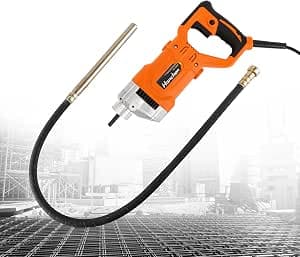
Hanchen Concrete Poker 1280W Concrete Vibrating Motor 5000r/min Aluminum Electric Industrial Vibrating Poker Vibrator with 2m Hose, Rod Diameter 35mm CE Certificated
Description
【Rod diameter 35mm】Suitable for most concrete construction, and has a wide range of uses.; 【Wide Applications】Surface smoothing and various prefabricated concrete members, etc.Widely used in the construction of buildings, highway guardrails and bridges, pouring cement vines, Roman columns, art columns, etc.; 【High Efficiency】 Strong vibration, low heat generation, low-noise,settle concrete quickly and remove air bubbles.; 【Good configuration】Copper high-temperature resistant motor; Gear secondary quenching, wear-resistant, smooth running; Duplex bearing reduce the high temperature generated by friction; High quality ABS casing has a good toughness; Closed dustproof switch; Double wire copper core.
One less thing to search
Before you buy: quick questions
Is the 35mm rod diameter suitable for my project, or do I need a larger/smaller size?
The 35mm rod is a versatile sweet spot for most residential and light commercial pours—think patios, footings, driveways, and small slabs (up to about 8 inches thick). If you're working on thicker mass concrete or stiff mixes like precast, you'd want a larger head (e.g., 45–50mm). For very thin overlays or tight spaces around rebar, a smaller 25mm head will maneuver better. Many DIYers on forums note that 35mm handles 90% of weekend projects without issue. ---
How loud is the Hanchen Concrete Poker during operation, and will it disturb the neighbors?
It's a concrete vibrator, so it's not whisper-quiet—expect around 85–90 dB at close range, similar to a lawnmower or angle grinder. It's acceptable for daytime use in residential areas, but you'll want hearing protection. If you're working near occupied homes, it's worth letting neighbors know beforehand or scheduling pours during reasonable hours. One Reddit user mentioned using it on a Saturday morning and getting a "friendly wave" from a neighbor rather than a complaint, so it's tolerable—just not silent. ---
Does the CE certificate mean it's safe and compliant for use in the US, or do I need a voltage converter?
The CE mark confirms it meets European safety and electromagnetic compatibility standards, but it doesn't guarantee UL or CSA certification for North America. The unit runs on 110–120V AC, which is standard for US outlets—so no converter is needed. That said, some users on YouTube noted they still ran it through a GFCI-equipped circuit and a quality extension cord (12-gauge or thicker) to be safe. If you're working commercially in the US, double-check whether your site requires UL-listed equipment; otherwise, it's plug-and-play. ---
Is this vibrator comfortable for one-handed use, especially on larger pours, or will my arm give out?
The 1,280W motor delivers serious vibration, so you'll feel it in your hand after 15–20 minutes of continuous use. For short bursts—like compacting around form edges or corners—it's fine with one hand. But for longer sessions, tackle it like a pro: alternate hands, use two hands when possible, and take breaks. Some users on construction forums suggest pairing it with an anti-vibration glove or wrapping the handle with extra grip tape if you're doing full-day pours. It's manageable, but it's not designed to be a "set it and forget it" tool. ---
What's the warranty and return policy like if the motor burns out or the hose kinks during the first week?
The Hanchen Concrete Poker typically comes with a 12-month warranty covering manufacturing defects and motor failure under normal use—not abuse or overloading. Most retailers offering this product, including Amazon, provide a 30-day return window for DOA (dead on arrival) units or early failures. A few reviewers mentioned that if the hose kinks and cracks within the first few uses, the seller usually honors a replacement, but it helps to photograph the issue immediately. Always keep your receipt and original packaging—one buyer noted that without the box, the return process was significantly harder. If you're concerned, look for a seller with a "replacement not repair" policy for the first 90 days.
From a similar, more-reviewed product in this category: YINMIK Digital pH Meter 4 in 1 pH Pen EC TDS Tester for Hydroponic Water
Does the YINMIK 4-in-1 pH meter come calibrated and ready to use?
The listing states the TDS/EC is calibrated before leaving the factory and can be used immediately out of the box, and it includes 4.00-7.00-10.01 pH calibration solution. One reviewer also said it arrived already calibrated.
Is it easy to set up and use?
Reviewers describe it as pretty easy to set up and use, and one noted it is simple to use with a reminder to rinse and dry the electrode after each use. The listing also says the simultaneous LCD display requires no mode switching for fast, intuitive monitoring.
How do I calibrate it for my water type?
The listing says pure water needs only a 7.0 calibration, acidic water needs 7.00 and 4.00, alkaline water needs 7.00 and 10.01, and if you don't know the water type, calibrate 7.00, 4.00, and 10.01.
Do the readings stay stable and consistent?
The listing says the improved probe with the latest program prevents readings from jumping around and takes about 5 seconds to obtain a reading. One reviewer said it seems to give consistent readings.
Is it good value for the price?
Reviewers called it decent value and a great bit of kit for the price, and one liked that the pH buffer pots allow storage with the pen fitting inside.
Answers are limited to the manufacturer's listing and the reviews we analysed. Questions those sources cannot support are not answered here.
Transparent by design