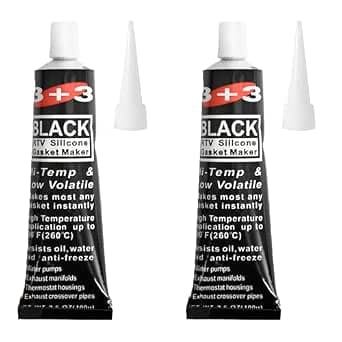
High Temperature Silicone Black Sealant, Body Sealant, Heat Resistant Silicone, Exterior Sealant for Cars and Machines, 100 g (2)
Description
TEMPERATURE RESISTANCE Black rubber silicone withstands temperatures up to 500 F and provides a reliable seal in high temperature environments; Durability The good sealing properties of silicone, even in high temperature or flame environments, make it ideal for industrial and domestic applications; Waterproof: Sealants are water, oil and frost resistant and can adapt to changes in the environment. Frost resistance provides long term protection and reliable sealing in rain and snow; Versatile use: body sealants are suitable for a wide range of applications, including sealing, insulation and seal manufacturing. It can be used in motors, heating systems, electrical components, ovens and industrial machinery as well as for moulding and casting processes; Easy to use: silicone sticks and applies smoothly, prevents cracking, shrinkage and adapts to temperature changes, making it suitable for professional and DIY use
Compare the trade-offs
Similar products, side by side
A random selection of analyzed products from the same category. Different products are not necessarily interchangeable.

One less thing to search
Before you buy: quick questions
What is the true heat resistance of this silicone, and what is it best used for?
This silicone is formulated for moderate to high heat applications commonly found in engine bays, such as valve covers, thermostat housings, and intake manifolds. Based on user experiences, it performs reliably for continuous temperatures seen in these areas. However, for extreme heat sources like exhaust manifolds or turbochargers, a dedicated copper or extreme-temperature sealant is recommended.
How much sealant is in a tube, and is one enough for a typical job?
Each tube contains 100 grams (approximately 3.5 oz) of sealant. For most common DIY jobs—like resealing a valve cover gasket on a 4-cylinder engine—one tube is sufficient. For larger V6 or V8 engines, or if you're sealing multiple components, purchasing two tubes is a safe bet to ensure you have full coverage without running out mid-job.
I've seen comments about the nozzle and curing time. What should I expect?
Some users have noted the nozzle can be prone to clogging if not cleaned immediately after use. We recommend having a spare nozzle or a set of picks on hand to clear any blockages. For curing, it will be dry to the touch in about 30-60 minutes, but requires a full 24 hours to cure completely. Many DIYers on forums stress the importance of waiting the full cure time before exposing it to fluids or heat for a lasting seal.
How should I prepare the surface to ensure it adheres properly?
Proper surface prep is critical for success. The area must be completely clean, dry, and free of oil, grease, or old sealant. Use a degreaser and a scuff pad or sandpaper to create a slightly rough surface for optimal adhesion. As noted in several project videos, skipping this step is the most common reason for adhesion failure.
How does this sealant compare to more expensive automotive brands?
This sealant offers excellent value for money and is a favorite among budget-minded DIYers for general sealing tasks. It provides strong, flexible adhesion comparable to leading brands for standard applications. The primary difference noted by users is that premium brands may offer marginally better nozzle design or slightly higher specified temperature ranges. For the vast majority of moderate-heat repairs, it is a highly effective and cost-efficient choice.
From a similar, more-reviewed product in this category: GAUDER Masking Film with Adhesive Tape, Painter's Film (3 Rolls, 140 cm x
Does the adhesive tape leave residue when removed?
Reviewers report that after removal there were no adhesive residues or other marks left on the wall. The manufacturer also states the film can be removed without leaving any residue.
Does the tape stick well on all surfaces?
One reviewer found it holds reasonably well on very smooth surfaces but barely adheres on slightly rough or textured surfaces, and the film fell down several times during work. The manufacturer, by contrast, states the film provides reliable protection even on slightly textured surfaces.
Is the film strong enough to stretch without tearing?
One reviewer was positively surprised that the film is noticeably more tear-resistant than expected, and that nothing tore even when pulled tightly.
Is the film thick or thin?
One reviewer described the cover film as somewhat thin, while still finding it helpful for their project.
How is the film applied?
The adhesive strip is already attached to the film, so you can stick it along a surface such as a window, unroll it to the desired length, and then cut it off. The manufacturer describes the same process: attach the tape, unfold the film, and cover the surface.
Answers are limited to the manufacturer's listing and the reviews we analysed. Questions those sources cannot support are not answered here.
Transparent by design