What people like
Impressive sound from compact size
Many reviewers are surprised by the full, immersive sound and decent bass these small speakers produce, often exceeding expectations for desktop use.
The 30-second read
What people like
Many reviewers are surprised by the full, immersive sound and decent bass these small speakers produce, often exceeding expectations for desktop use.
The main watch-out
Several users report muffled vocals or midrange issues that require EQ to fix, and some find the bass lacking without a subwoofer, especially for the price.
Before you choose
Consider the physical footprint on your desk and whether Bluetooth stability or USB-C input meets your setup, as some users had pairing issues.
From a similar, more-reviewed product in this category: Edifier G2000 32W PC Computer Speakers for Gaming Desktop PC Laptop Mac Computer Woofer Speakers Bluetooth USB 3.5mm AUX Inputs RGB Lights Multimedia Speakers Pink
What people like
Reviewers repeatedly praise the clear, loud sound and surprisingly strong bass for such small speakers, often calling them a great value.
The main watch-out
One reviewer emphasizes this is a two-speaker setup with no subwoofer, so deep bass may be limited unless you add a powered subwoofer.
Before you choose
These are compact speakers with Bluetooth, USB, and AUX inputs, but you must switch modes with a button and cannot use multiple inputs at once; also note the small size.
Your use case first
27 of 131 mentions describe a negative experience (21%).
3 of 30 mentions describe a negative experience (10%).
1 of 16 mentions describe a negative experience (6%).
3 of 14 mentions describe a negative experience (21%).
2 of 11 mentions describe a negative experience (18%).
15 of 44 mentions describe a negative experience (34%).
8 of 19 mentions describe a negative experience (42%).
5 of 13 mentions describe a negative experience (38%).
One review can mention several topics. Percentages describe the reviews we analysed, not all buyers or the product's overall failure rate.
From a similar, more-reviewed product in this category: Edifier G2000 32W PC Computer Speakers for Gaming Desktop PC Laptop Mac Computer Woofer Speakers Bluetooth USB 3.5mm AUX Inputs RGB Lights Multimedia Speakers Pink
209 of 969 mentions describe a negative experience (22%).
59 of 352 mentions describe a negative experience (17%).
3 of 144 mentions describe a negative experience (2%).
10 of 141 mentions describe a negative experience (7%).
31 of 140 mentions describe a negative experience (22%).
29 of 123 mentions describe a negative experience (24%).
20 of 87 mentions describe a negative experience (23%).
48 of 117 mentions describe a negative experience (41%).
Compare the trade-offs
A random selection of analyzed products from the same category. Different products are not necessarily interchangeable.

OHAYO 60W Computer Speakers, Bluetooth 5.3, Stereo 2.0, 1 Pair, Black

Edifier M60 Multimedia Speaker Bluetooth 5.3, 66W RMS, Hi-Res Audio & Hi-Res Wireless Audio, LDAC,3" Mid Bass & 1" Tweeter, USB-C & Aux Inputs, Compact Desktop Speaker – Black

Kanto ORAMB 100W Powered Reference Desktop Computer Speakers with Bluetooth 5.0 and USB-C Input | Bi-Amplified | 100 Hz Automatic Crossover | Reference Quality Sound | Pair | Black
Check the evidence
Included does not mean verified authentic. Flagged does not mean proven fake. These are analytical classifications.
Showing 3 illustrative excerpts, not the complete review set.
Needs EQ to fix muffled vocals. Not "DSP Tuned reference quality"
“Pros: - Compact design with decent bass (50–70 Hz) for the size - Built-in USB DAC ensures low-noise PC connectivity - Flat base and treble - Sounds acceptable—but only after applying EQ to correct vocal issues Cons: - Muffled Vocals: Voices sound as if underwater, with a noticeable midrange abnormality (confirmed using a UMIK-2 mic). Despite being marketed as “DSP tuned” and “reference quality,” the speakers require careful manual EQ to fix this flaw. - Limited Connectivity: EQ fixes work only via RCA or USB; Bluetooth (which is limited to SBC, no AptX) won’t apply EQ unless you use a phone app like SpotEQ31. - Harsh Treble: Sibilance makes strings sound scratchy unless corrected with treble roll-off in the EQ. - Channel Layout: The main speaker is always on the right, with no ability to swap. - Paper Cone Woofers: These may compromise both sound quality and longevity. Not acceptable at this price. EQ Adjustments: Preset 1 – Correcting Vocals & Midrange Defects: 20 Hz: 0dB 25 Hz: 0dB 32 Hz: 0dB 40 Hz: 0dB 50 Hz: 0dB 63 Hz: +0.5dB 80 Hz: +1dB 100 Hz: +0.5dB 125 Hz: 0dB 160 Hz: 0dB 200 Hz: 0dB 250 Hz: 0dB 315 Hz: 0dB 400 Hz: -1.7dB 500 Hz: -2.5dB 630 Hz: -1.8dB 630 Hz: -0.9dB 1 kHz: +1.4dB 1.2 kHz: -1.4dB 1.6 kHz: +1.1dB 2 kHz: +2.6dB 2.5 kHz: +2.6dB 3.1 kHz: +2.2dB 4 kHz: +3.5dB 5 kHz: +1.5dB 6.3 kHz: 0dB 8 kHz: 0dB 10 kHz: 0dB 12 kHz: 0dB 16 kHz: 0dB 20 kHz: -2.5dB Preset 2 – Normal Vocals and Midrange, Enhanced Bass & Treble: 20 Hz: 0dB 25 Hz: 0dB 32 Hz: +1dB 40 Hz: +2dB 50 Hz: +3dB 63 Hz: +3.5dB 80 Hz: +4.5dB 100 Hz: +3.3dB 125 Hz: +1.4dB 160 Hz: +1.4dB 200 Hz: +1.4dB 250 Hz: +1.1dB 315 Hz: 0dB 400 Hz: -1.7dB 500 Hz: -2.5dB 630 Hz: -1.8dB 630 Hz: -0.9dB 1 kHz: +1.4dB 1.2 kHz: -1.4dB 1.6 kHz: +1.1dB 2 kHz: +2.6dB 2.5 kHz: +2.6dB 3.1 kHz: +2.2dB 4 kHz: +3.5dB 5 kHz: +1.2dB 6.3 kHz: +0.9dB 8 kHz: +1.2dB 10 kHz: +1.3dB 12 kHz: +2.0dB 6.3 kHz: -2dB 16 kHz: +1dB 20 kHz: -3dB 20 kHz: -5dB Using either preset significantly improves the sound by eliminating the muddled vocals. Preset 2 is better for music, preset 1 is better for audiobooks and youtube. Overall Verdict: While the Kanto ORA’s compact size and basic sound performance are appealing, its factory DSP tuning falls short—forcing you to manually EQ to fix muffled vocals and harsh treble. It is perplexing that Kanto did not use its DSP to calibrate the speakers properly. That's a huge missed opportunity. I am not sure what Kanto audio engineers were doing here. They could have used a basic UMIK-2 calibration mic to see the easily fixable flaws. I hope they can release a firmware update to fix the sound signature. At this price, bluetooth codecs like AptX (or Snapdragon Sound) and proper out-of-the-box EQ should be standard. If you have room on your desk, alternatives such as the JBL 305 MKII offer gold-standard performance, backed by superb audio engineering, without needing manual EQ. Consider the Kanto ORA only if compact speakers are a must and you’re willing to invest time in fine-tuning the sound with EQ software.”
Signals matched: Specific detail: quantity, entity, comparison, process · Mentions: sound quality, size, connectivity, build quality · Reads as an authentic voice
Excellent desktop speakers
“The Kanto ORA is a really good pair of desktop speakers. They have a pretty flat and laid-back sound. The bass with the unit itself sounds good, but it still doesn't produce much sub-bass (as expected of a speaker this size). If you don’t listen to a lot of bass-centered tracks, then you would not necessarily need a subwoofer with this. Connecting a subwoofer (I used a Kanto Sub8) activates the crossover (at 100Hz), allowing the ORA to focus its power on the mids and highs, producing a well-rounded, full-range sound. I bought this to replace my KEF Q100 + Pioneer SW-8MK2 + SMSL AD18 DAC/AMP setup, which was taking up a lot of space on my desk. Using a passive speaker also meant adding an amplifier and all the additional wires required, making the desk a mess. The ORAs are tiny in comparison and are powered, simplifying the setup considerably. One huge quality-of-life improvement for me with the ORA is that I can change its volume at the OS level (via keyboard) like an analog connection, even when connected via USB. I do this hundreds of times a day and don’t have to take my hands off the keyboard now. It is still a little confusing as the speaker volume (controlled via knob) and system volume are independent, and I am not sure how it’s affecting the subwoofer volume (it was at 50% with the SMSL, but I had to reduce it to 25% with the ORA). It took me a day or two of tinkering to get the volumes at a balanced state. @Kanto, if you are reading this, I hope you can share a guide on how to balance system, speaker, and subwoofer volumes, especially within the Kanto ecosystem. After dialing in the ORA and the Sub8, I compared it to the larger KEF system, and it was a tough one. The KEF, thanks to its coaxial drivers, sounded more magical than the Kanto. The imaging on certain tracks is out of this world, but on the flip side, they do sound thin and fatiguing with other songs (even though they are not bright speakers). The Kanto, on the other hand, sounded more laid back and neutral, which makes it a bit boring but more consistent across the range of songs I tried. At the end of the day, I prefer and am keeping the kanto setup for the desk, due to its size, laid-back neutral sound, simplicity, and other convenience features. The ORA feels well-tuned and optimized for the desk. If you want a speaker that you would like to move from the desk to the living room when needed, there are many other excellent (but larger) speakers at this price point that might serve you better. If this was priced around $249, it would have been a no-brainer recommendation.”
Signals matched: Specific detail: entity, comparison, process · Mentions: sound quality, size, connectivity · Reads as an authentic voice
Make sure to run an EQ if you want to enjoy your music through these.
“If you’re planning to use these as PC speakers, I highly recommend installing Equalizer APO right away. Seriously. It makes a massive difference, and I would not suggest running these speakers without some kind of EQ. I’m generally a fan of these speakers. I’m not an audiophile, but I do care about clear, balanced sound. Out of the box, though, I was honestly pretty close to returning them. Without EQ, the soundstage feels very flat, like everything is coming from the same place instead of having any real depth or separation. On top of that, they sound very muddy, especially with rock or metal. Once there are a lot of instruments happening at the same time, everything blends together and it starts to sound dirty. To be fair, these are reference speakers, and I probably should have taken that more into account before buying them. They are clearly tuned to be neutral rather than exciting right away. That said, there are some real positives even before EQ. The bass response by itself is surprisingly strong and solid for small four inch drivers, and it is perfect for an apartment setup without shaking the walls. The highs on their own are also very clear and crisp without being overbearing or shrill. The speakers do not sound hollow at all, which I really appreciate. Once I installed Equalizer APO and boosted the highs and lows a bit, everything came together. The soundstage opened up, instrument separation improved a lot, and the overall clarity jumped way up. With a few EQ tweaks, these speakers end up sounding very well balanced. Because of that, I decided to keep them. With EQ, they sound great for listening to music, watching movies, and even playing games. Without EQ, I really would not recommend them unless you're looking for studio monitors. One small but annoying thing to note: the speakers are not labeled left and right. The one with the volume knob is the left channel. If you are like me and running these to a PC, you will probably put that speaker on the right side closest to your tower so you do not have to run a long USB C cable across your desk. The downside is there is no built in way to swap channels on the speakers themselves, so you will need software like Equalizer APO to reverse them. Overall, these are very good value for your dollar. They absolutely need EQ to shine, but if you are willing to do a little setup, they become a really well balanced set of speakers for everyday use.”
Signals matched: Specific detail: entity, process, scenario · Mentions: sound quality, suitability for desktop use · Reads as an authentic voice
One less thing to search
The listing states ORA has three inputs: USB-C for PC or Mac, Bluetooth 5.0 for phones or smart home devices, and RCA for analog gear. One reviewer noted they connected theirs via USB-C.
Reviews are mixed on this: one reviewer said the bass sounds good but produces little sub-bass and a subwoofer isn't necessary unless you listen to bass-heavy tracks, while another said they have good bass but still need a sub for punch. The listing notes a 100 Hz automatic crossover engages when a subwoofer is connected.
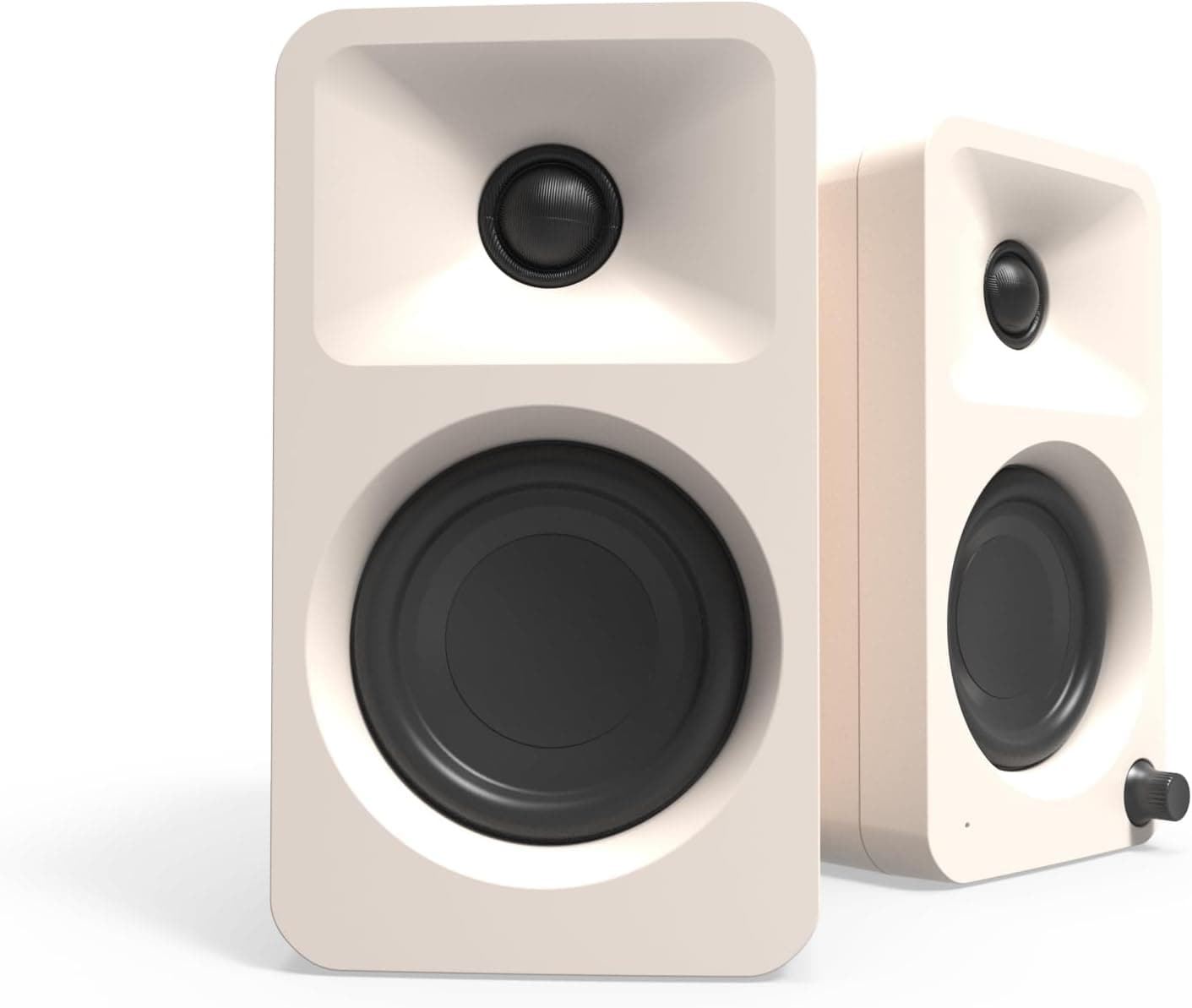
Reviewers consistently describe them as compact yet powerful, with one noting they look noticeably large on a 42-inch desk but not comically so, and about as large as they would go for a small desk. The listing says ORA is small enough to place sideways under a monitor.
Two reviewers recommended running EQ: one said installing Equalizer APO made a massive difference and would not suggest running the speakers without some kind of EQ, and another reported muffled vocals that required EQ correction. Other reviewers described the sound as flat, laid-back, and impressive without mentioning EQ.
Review opinions differ: some reviewers called the sound quality impressive and immersive despite the high cost, while others felt they were not worth the price tag, with one calling them a $150 speaker at best and another citing disappointing quality for the price.
From a similar, more-reviewed product in this category: Edifier G2000 32W PC Computer Speakers for Gaming Desktop PC Laptop Mac Computer Woofer Speakers Bluetooth USB 3.5mm AUX Inputs RGB Lights Multimedia Speakers Pink
Yes. The manufacturer states there is a sub-out interface on the back of the unit, and you can connect it to any full-range active subwoofer.
Yes. The G2000 has both volume and lighting memory, so as long as you turn it off using the power button, it will keep your preferred volume level and lighting mode the next time you power it on.
Reviewers consistently describe them as delivering big, clear sound with surprisingly good bass for their compact size, with one noting the bass is solid thanks to the rear port and another saying they surpassed expectations compared to previous cheap desktop speakers.
The listing states they support 3.5mm AUX, Bluetooth, and USB sound card inputs for devices like PC, Mac, PS4, Xbox, laptop, TV, CD player, and mobile phones. Reviewers confirm using Bluetooth, AUX, and USB, and one notes you can't use them all at the same time since you have to switch modes with a button on the speakers.
Yes. The manufacturer states you can adjust the RGB lighting to match different moods or turn it off entirely, and the listing mentions 12 RGB lighting effects. Reviewers say the RGB looks great with a gaming setup without being too over-the-top.
Answers are limited to the manufacturer's listing and the reviews we analysed. Questions those sources cannot support are not answered here.
Transparent by design