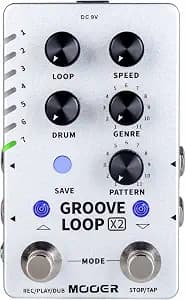
MOOER Groove Looper Pedal Drum Machine Stereo Guitar Loop Recorder Pedals | With 140 Minutes Loops, 14 Save Slots, 121 Drum Grooves, Editor Software (X2)
Description
MOOER Groove Loop X2 combines a stereo looper and drum machine in one pedal. Offers 14 save slots, each capable of storing loops up to 10 minutes in length, for a total of 140 minutes of stereo recording time; Built-in drum machine with 121 drum grooves across 11 musical genres, each genre containing 11 variations. GENRE and PATTERN knobs provide direct selection of grooves; Three recording modes available: Count-in mode, Automatic mode (starts when instrument signal is detected), and Normal mode; TIME STRETCH function allows playback speed adjustment without affecting pitch; Justify function ensures drum groove and loop stay perfectly in sync. Looper and drum machine audio can be routed to separate outputs; Tap Tempo supported for manual tempo setting; automatic tempo detection when used with looper; 4.1kHz/24-bit stereo recording quality. Supports import of MP3/WAV/FLAC/APE audio files and export of WAV files via the dedicated editor software; Stereo 1/4-inch inputs and outputs, plus 1/8-inch external control output for footswitch connection. Powered by 9V DC adapter (300mA, center negative). Editor software available for track management and firmware updates
One less thing to search
Before you buy: quick questions
I'm used to simple loopers. How difficult is it to use the drum machine and looper features together without a manual?
There's definitely a learning curve, but it's manageable. The workflow revolves around choosing a drum groove first and then using the looper as you normally would. The main challenge is navigating the compact interface to switch drum patterns mid-loop or tweak settings, which requires a bit of menu-diving. New users often find it easiest to use the bundled editor software to set up their favorite drum grooves into the save slots, so they can just tap through them on the pedal during practice. It takes an afternoon to get fluent, but the payoff of having drums and loops in one box is worth it.
The pedal is advertised as "Stereo." Will I have any issues running my stereo effects pedals into it?
This is a common concern among users. While the output is stereo and the internal drum machine sounds spacious, some guitarists found that the input routing is designed for a standard mono instrument cable. In practice, many users run a mono guitar signal into the pedal and rely on its internal effects to generate the stereo width on the output. If you specifically need to loop your own stereo effects chain (with a TRS "insert" cable or two separate inputs), this might not be the most straightforward option. For most guitarists, it works perfectly as a stereo output pedal, but not necessarily as a stereo input looper.
What power supply do I need, and will it work with my current pedalboard setup?
The MOOER Groove Looper requires a standard 9V DC power supply with a center-negative tip, drawing approximately 300mA of current. Like many compact pedals, it does not come in the box. It's best to use a dedicated, isolated power output on your pedalboard supply (such as a Voodoo Lab or Cioks) to avoid any grounding hum. Many users report that using a "daisy chain" power cable with high-draw digital pedals can introduce noise, so an isolated output is highly recommended. If you don't have one, a standard single 9V adapter will work fine.
I want to use the editor software. What do I need to know about connecting to my computer and saving my loops?
The editor software is primarily for managing presets, adjusting drum groove parameters, and organizing your 14 save slots—it is not a full audio interface for streaming your guitar into a DAW. You'll connect the pedal to your computer via the USB-C port to manage the loops and settings. A common tip from users is to save your custom drum kit configurations to the pedal's internal memory before unplugging, as some firmware versions have been known to reset settings if the software isn't closed properly. It's a powerful organizational tool, but it works best for setup rather than live jamming.
Is this a good replacement for having a separate drum machine and looper? Who is this pedal actually for?
For the home musician and songwriter, this is an excellent space-saving tool. It’s ideal for practice, writing riffs over different beats, and building quick stereo demos. However, if you are a gigging musician who relies on tight MIDI sync from a click track or needs to switch complex arrangements flawlessly mid-song, you might find the control surface limiting compared to dedicated units like the Boss RC-5. In short: it's a brilliant sketchpad and practice tool for Bedroom Rockstars, but maybe not a road-worthy centerpiece for complex live electronic sets.
From a similar, more-reviewed product in this category: WINGO Guitar Capo for Acoustic Electric Guitars-Rosewood Color with 5 Picks
What instruments is this capo compatible with?
The listing says it suits steel string acoustic and electric guitar, banjo, mandolin, or ukulele well. The product details also list acoustic guitar, banjo, bass guitar, electric guitar, mandolin, and ukulele.
Does the capo come with picks?
Yes. The package includes 1 rosewood finish guitar capo and 5 medium celluloid picks (0.71mm) in a color box.
Will the capo scratch or damage my guitar?
The listing states it is made of high-grade aluminum alloy with a silicone pad designed to protect your guitar from scratches or damage.
Is it easy to move or remove quickly?
The listing says it has a quick release, can be clipped on and changed quickly, and can even be moved or removed with one hand, so you can change keys during a song.
Does it produce a clear tone without buzzing?
The listing states it has well-balanced pressure for a clear tone with a strong spring, and promises a beautiful sound without buzz.
Answers are limited to the manufacturer's listing and the reviews we analysed. Questions those sources cannot support are not answered here.
Transparent by design