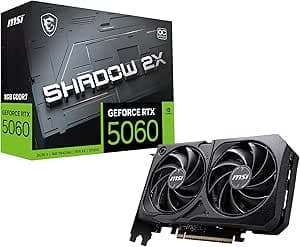
MSI GeForce RTX 5060 8G SHADOW 2X OC Graphics Card - 8GB GDDR7 (28Gbps/128-bit), PCIe 5.0 - HDMI 2.1b, 3 x DisplayPort 2.1b
Description
MSI GeForce RTX 5060 8G SHADOW 2X OC
One less thing to search
Before you buy: quick questions
Is the 8GB of VRAM on the RTX 5060 enough for modern gaming, or will it be obsolete quickly?
For smooth 1080p gaming at max settings, 8GB of GDDR7 is currently excellent, which is what most positive reviews highlight. However, many tech-focused discussions on Reddit point out that some newer, unoptimized games can already exceed 8GB at 1080p with ray tracing enabled. If you plan to game at 1440p or want to "future-proof" for several years, you might want to consider a card with more VRAM, like an RTX 4070 or AMD alternative.
Will this graphics card fit in my case and work with my power supply?
The MSI SHADOW 2X OC is a relatively compact dual-slot card, making it a great fit for most mid-tower and many small form factor cases. It's also very power-efficient. A quality 550W power supply is sufficient for most systems using this card, so if you're upgrading from an older mid-range GPU, your current 600W-650W PSU should handle it without issue.
I've seen comments that this is just a rebadged last-gen card. How does it really compare to an RTX 4070 or AMD's RX 7700 XT?
The RTX 5060 shines in efficiency and modern features like DLSS 3.5. For pure 1080p performance, it's very competitive. The common comparison you see online is that the RTX 4070 (with 12GB VRAM) is stronger for 1440p, while the AMD RX 7700 XT (also 12GB) often offers better raw performance at a similar price point but lacks NVIDIA's DLSS tech. The "value" decision often comes down to your resolution, preference for NVIDIA's features, and current sale prices.
Are there any common issues with thermals, noise, or software?
Most users report good thermal performance during standard gaming. Some note the fans can become audible under heavy load, which is typical for dual-fan designs. A few early adopters mentioned driver instability, but NVIDIA and MSI have released updates that have largely resolved these teething issues. As with any new hardware, installing the latest drivers from NVIDIA's website is recommended.
Who is this graphics card the best fit for?
This card is an ideal upgrade for gamers currently on GTX 10 or 20-series cards (or older) who want exceptional 1080p performance with modern features like ray tracing and DLSS. It's also perfect for builders creating a new, efficient mid-range PC. It may not be the best fit for enthusiasts targeting 1440p ultra settings for years to come or for those who prioritize maximum VRAM over cutting-edge feature sets.
Answers are limited to the manufacturer's listing and the reviews we analysed. Questions those sources cannot support are not answered here.
Transparent by design