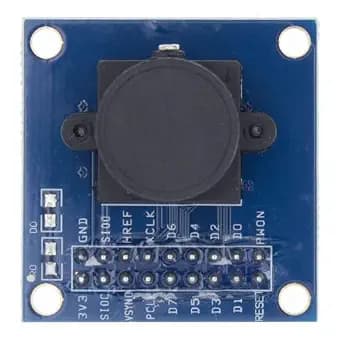
OV7670 VGA CMOS Camera Module 640x480 0.3MP Video Capture Board with I2C Interface 25° FOV Compatible with UNO Rduino ARM STM32 FPGA DIY Electronics Robotics Projects
Description
Overview: The OV7670 VGA CMOS Camera Module is a compact and efficient image sensor solution featuring 640x480 resolution for embedded vision projects. With an integrated I2C interface, it seamlessly communicates with microcontrollers including UNO, Rduino, ARM, and FPGA platforms. Key Features: - High-performance 0.3 Megapixel (300KP) CMOS sensor - I2C compatibility with SCCB-like interface for easy microcontroller integration - Frame sync (VSYNC), line sync (HREF), and pixel clock (PCLK) outputs for precise image timing - Low power consumption with sleep current <20μA - Small 1/6" form factor and 25° field of view for embedded applications Technical Specifications: - Resolution: 640x480 pixels VGA - Power Consumption: 60mW at 15fps - Operating Voltage: IO: 2.5V–3.0V, Core: 1.8V - Output Format: YUV, YCbCr4:2:2, RGB565/555/444, GRB4:2:2, Raw RGB - Signal to Noise Ratio: 46dB; Dynamic Range: 52dB - Operating Temperature: -30°C to 70°C - Pixel Area: 3.6μm x 3.6μm; FOV: 25° Applications: - DIY electronics and robotics - Image processing and machine vision - Educational development boards - Home automation and surveillance - Embedded vision in STM32, FPGA, and Rduino systems
One less thing to search
Before you buy: quick questions
I'm new to microcontrollers. Is this camera module beginner-friendly?
We recommend this module primarily for intermediate to advanced hobbyists, electronics students, or those specifically seeking a deep-dive learning project. While it's a fantastic low-cost educational tool, many beginners on forums like Reddit have expressed frustration with the need for additional components (like resistors for pull-ups) and the technical challenge of configuring it via I2C registers. If you're looking for a simpler "plug-and-play" camera for Arduino, you might want to research modules with built-in JPEG compression like the OV2640 first.
What else do I need to buy to get this working with my Arduino Uno?
The module itself is just the sensor board. To connect it to a 5V Arduino Uno, you will likely need: 1) A 3.3V voltage regulator or dedicated power source, as the OV7670 is a 3.3V device. 2) 10K ohm resistors to act as pull-ups on the I2C lines (SCCB). 3) Jumper wires. A common tip from successful users is to also get a small breadboard for easier connections. It does not come with a ribbon cable or any mounting hardware.
How is the image quality and can I adjust the focus?
This is a basic VGA (640x480) sensor. Users report it provides a functional image for machine vision or basic monitoring projects, but it can be grainy in lower light. Please note: The lens has a fixed focus, set for distances of roughly 1 meter to infinity. As noted in several YouTube reviews, this makes it less ideal for close-up object detection. The field of view is a standard 25 degrees.
Is it compatible with the latest Arduino boards like the UNO R4 or ESP32?
The sensor is compatible in principle, but the main challenge is software library support. For the UNO R4 (which uses a Renesas chip), many older OV7670 libraries designed for AVR-based boards (like the UNO R3) may not compile directly. For ESP32, you'll need libraries tailored for its dual-core architecture. We advise checking dedicated GitHub repositories and community forums for your specific board *before* purchasing, as you may need to adapt existing code.
I'm concerned about receiving a damaged module. How is it packaged?
This is a valid concern we've seen echoed in user feedback. These are low-cost, industrial-style modules and have historically been shipped in minimal anti-static packaging. While we inspect all units, the postal process can sometimes bend the delicate pins. We double-check every module before dispatch and are committed to resolving any DOA (Dead On Arrival) issues. If you receive a damaged unit, please contact our after-sales service with photos for a prompt replacement or refund.
Answers are limited to the manufacturer's listing and the reviews we analysed. Questions those sources cannot support are not answered here.
Transparent by design