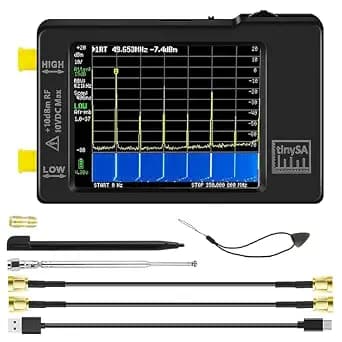
Portable Tinysa Spectrum Analyzer, AURSINC V0.3.1 Handheld Frequency Analyzer, Signal Generator 100kHz to 960MHz MF/HF/VHF UHF Input ESD Protected Function with 2.8 inch Touchscreen
Description
[Tiny Spectrum analyzer] AURSINC Tinysa spectrum analyzer produced by Hugen, with hardware V0.3.1. The firmware of the tinySA can be updated, for newest firmware version update, please refer to: tinysa .org. The version info displayed indicates "ESD Protection" with a diode to improve stability, sensitivity, anti-static level, and longevity; [Frequency Range] The tiny sa spectrum analyzer with two inputs, high quality MF/HF/VHF input for 0.1MHZ-350MHz, lesser quality UHF input for 240MHz-960MHz. Switchable resolution bandpass filters for both ranges between 2.6kHz and 640kHz. The tinysa includes all the components of a traditional heterodyne swept spectrum analyzer, with a color display showing 290 scan points covering up to the full low or high frequency range; [Built-in Calibration Signal Generator] When not used as Spectrum Analyzer it can be used as Signal Generator, MF/HF/VHF sinus output between 0.1MHZ-350MHz, UHF square wave output between 240MHz-960MHz. Built-in calibration signal generator enables automatic self-test and low input calibration; [PC Control] The USB interface realizes the Serial over USB (CDC) protocol and a large number of commands can be called through the serial interface. The commands can be used for measurements or updating internal settings. The Windows driver will automatically install upon connecting to a Windows PC. The driver for Linux is built into the kernel. Tinysa-APP is available to control the tinysa and capture its screen; [Package List] 1x Tiny Spectrum Analyzer(Bulit-in 500mah battary, 2.8inch touchsreen) ; 2x 20cm/7.87inch RF Cable; 1x USB-C Cable ; 2x SMA Female to Female Connector; 1x Touchscreen Pen; 1x SMA Telescopic Antenna
One less thing to search
Before you buy: quick questions
Is the TinySA accurate enough for professional RF work, or is it more of a hobby tool?
Most users find it excellent for hobby-level signal hunting, antenna tuning, and basic spectrum monitoring up to 960 MHz. However, several Reddit and YouTube reviews note that it can drift slightly after extended use and lacks the calibration rigor of lab-grade analyzers. For critical field measurements, many recommend it as a spot-check tool rather than a primary instrument.
How durable is the build — will it hold up in a backpack or outdoor setup?
The device is lightweight and portable, but some buyers mention the plastic case feels less rugged than expected, and the USB port can be fragile. TikTok users suggest investing in a carrying case or using a right-angle USB cable to reduce strain. It’s fine for careful indoor or sheltered use, but not recommended for rough outdoor environments.
Can I use this with my existing SDR setup (like an RTL-SDR or HackRF)?
Yes, the TinySA works well as a standalone spectrum analyzer and can complement SDRs for broader frequency analysis. A common setup is to use it for pre-scanning signals before feeding them into your SDR software. Just note that the input is ESD-protected, but several reviews advise against connecting it directly to high-power antennas without an external attenuator.
What about returns if the touchscreen has dead pixels or the unit arrives defective?
AURSINC typically offers a 30-day return window, but some customers report mixed experiences with support response times. If you receive a defective unit, file a claim immediately with photos. Buying through a platform with buyer protection (like Amazon) is recommended. The FAQ on the product page lists the warranty terms — check those before purchase.
How does this compare to the newer TinySA Ultra or a NanoVNA?
The TinySA V0.3.1 is a solid entry-level option, but the Ultra model offers a higher frequency range (up to 3 GHz) and a better build. The NanoVNA V2 is more for vector network analysis (SWR, impedance) rather than spectrum monitoring. If you’re primarily hunting signals below 1 GHz and want to save money, the V0.3.1 is fine. If you need higher frequencies or a sturdier unit, consider saving up for the Ultra or a NanoVNA alternative.
Answers are limited to the manufacturer's listing and the reviews we analysed. Questions those sources cannot support are not answered here.
Transparent by design