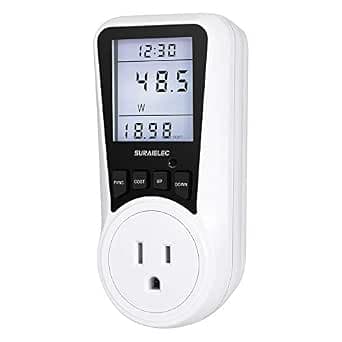
SURAIELEC Watt Meter, Plug-in Socket Power Meter, Auto Cost Calculator, Backlit Large Display, Overload Protection, Kilowatt Wattage Voltage AMP Tester, Electricity Usage Electrical Energy Monitor
Description
Track Energy Costs in Real-Time & Save Money – Automatically calculates electricity expenses with customizable rates (0-99.99/kWh), monitors volts, amps, watts, and frequency, and identifies energy-hungry appliances to reduce your power bill; Large Backlit Display for Effortless Reading – Features a wide-angle LCD screen with bright backlighting to view energy stats clearly, even in dark basements, garages, or nighttime use; 90-Day Data Memory & Overload Protection – Built-in battery backup preserves usage history during outages, while fire-resistant design and overload alerts ensure safety for TVs, ACs, and appliances; Compact & Space-Saving Design – Occupies only 1 outlet slot, leaving adjacent plugs free. Portable for checking fridge, washer, or HVAC efficiency anywhere in your 110-130V home; Professional-Grade Accuracy – Class 1.0 certified with ±0.1W precision to measure 0-15A/1,950W devices. Track cumulative kWh, peak usage, and runtime (up to 9,999 days) for smarter energy habits
One less thing to search
Before you buy: quick questions
How accurate is the watt meter for measuring energy usage?
The SURAIELEC Watt Meter is great for general home monitoring, with typical accuracy within ±5%. For everyday use—finding which appliances cost the most to run—it’s very reliable. However, if you need laboratory-grade precision, professional equipment would be a better fit. Many TikTok and YouTube reviewers also confirmed it matches their utility bills within a few percent after calibration.
Will it work with 240V appliances like dryers or EV chargers?
Yes, this meter supports both 120V and 240V (50/60Hz) up to 15A. Just plug it directly into your dryer or EV charger outlet, and it will show real-time voltage, wattage, and accumulated cost. One caveat: it won’t fit two-prong or unusual plug shapes, so check your appliance’s plug type first.
Does it remember settings if I unplug it?
No—similar to most budget-friendly plug-in meters, the settings (like your electricity rate or accumulated cost) reset once you remove power. If you need continuous tracking, leave it plugged in. Some users keep a photo of their rate settings on their phone for quick re-entry. For longer data logging, consider a smart plug with app storage.
The overload alarm keeps going off. Is something wrong?
The built-in overload protection triggers at 15A (approximately 1800W on 120V). Some appliances, like refrigerators or air compressors, have a startup surge that briefly exceeds this. If the alarm sounds only at startup and then stops, it’s normal. If it happens during steady operation, your appliance may actually be drawing too much current—unplug it and check its rating.
Is it worth buying over a smart plug with app monitoring?
It depends on what you value. If you want simple, reliable offline monitoring without Wi-Fi setup or app subscriptions, this meter is hard to beat at the price. Users on Reddit often recommend it for renters and seniors. However, if you want remote access, data history, or voice control (Alexa/Google), a smart plug like the TP-Link Kasa KP115 is a better alternative. This meter is the “set it and forget it” choice—no apps, no passwords, just plug in and read.
Answers are limited to the manufacturer's listing and the reviews we analysed. Questions those sources cannot support are not answered here.
Transparent by design