What people like
Ambitious, mind-expanding 3-in-1 blend
Reviewers call it thought-provoking and immersive, praising how one book combines a psychology guide, a bold cosmic theory and a dystopian story.
The 30-second read
What people like
Reviewers call it thought-provoking and immersive, praising how one book combines a psychology guide, a bold cosmic theory and a dystopian story.
The main watch-out
Some readers found the ambitious reach hard to digest, describing it as not a comfort read and noting the dystopian novel's story divided opinion.
Before you choose
It is three distinct works in one binding; the last is the dystopian novel Children of Jotunheim, so expect fiction mixed with the philosophy.
From a similar, more-reviewed product in this category: Don't Believe Everything You Think: Why Your Thinking Is The Beginning & End Of Suffering (Beyond Suffering Book 1)
What people like
Reviewers call it simple and comforting, helping them see thoughts differently, feel calmer and less anxious; several name it a favorite.
The main watch-out
A 3-star reviewer says the overthinking insights are useful but the wording and philosophy can feel misleading or oversimplified.
Before you choose
It's described as a quick, easy read, so check whether you want a brief introduction or a longer, more detailed book.
Description
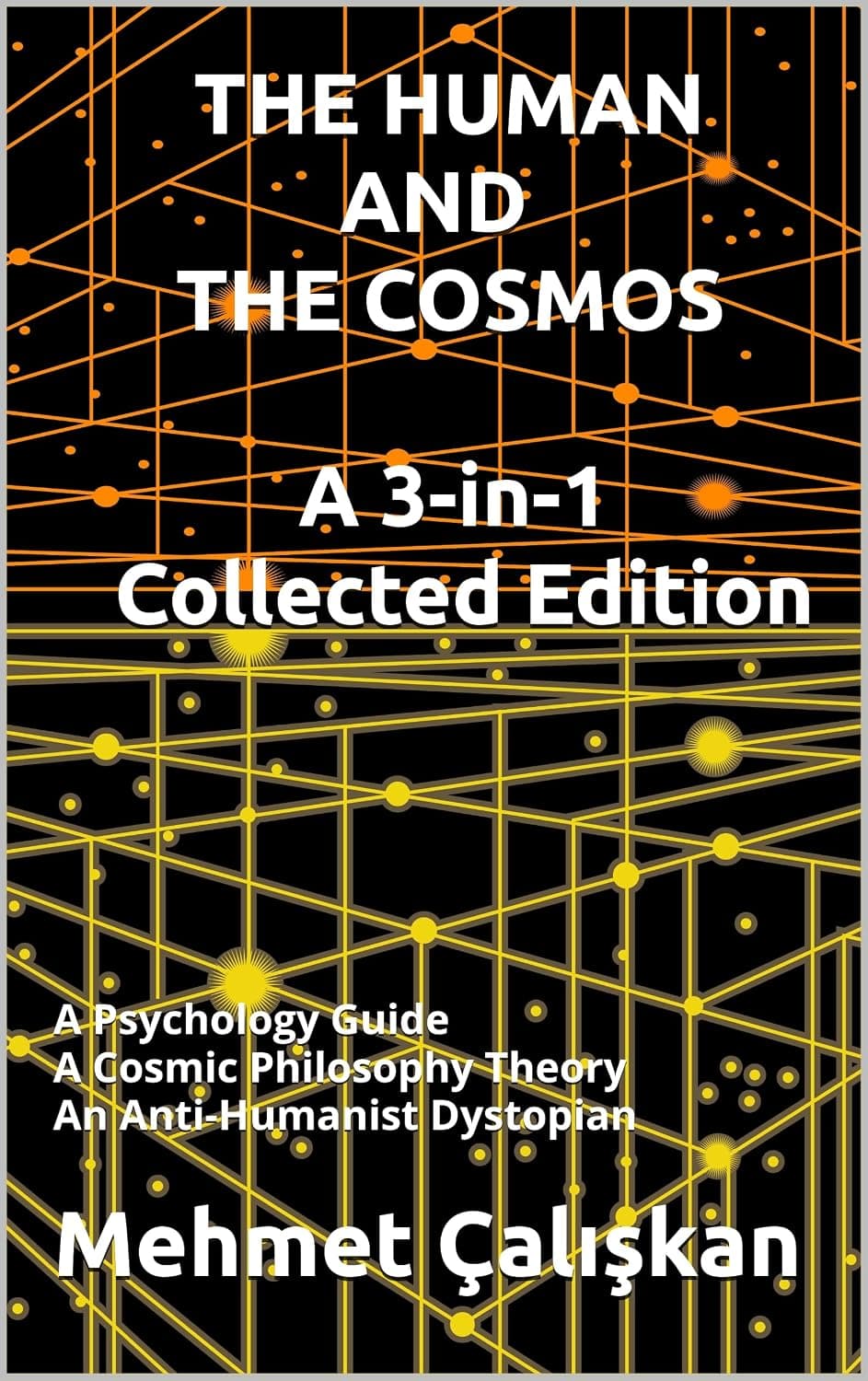
A psychology guide. A cosmic philosophy. An anti-humanist dystopia. The Human and the Cosmos is a three-in-one work connecting the human mind, the structure of the universe, and the future of civilization. Book One – The Mind’s Operating System Explores the mind as a system of codes, memory, and consciousness—offering tools for self-awareness without quick-fix promises. Book Two – The Big Crunch Presents a cyclical model of existence, where time, energy, and consciousness operate through a unified principle: Move, Unite, Fragment. Book Three – Children of Jotunheim A dystopian narrative exploring the consequences of intelligence without responsibility. This work is an unsettling yet illuminating thought experiment for readers drawn to psychology, philosophy, and cosmology. Read it not to be comforted—but to become aware. Read more
Compare the trade-offs
A random selection of analyzed products from the same category. Different products are not necessarily interchangeable.
Check the evidence
Included does not mean verified authentic. Flagged does not mean proven fake. These are analytical classifications.
Showing 3 illustrative excerpts, not the complete review set.
Profoundly Deep!!
“We've all heard the expression, "go big or go home." Well, "The Human and the Cosmos" is an ambitious work with a well-deserved second reading of my attention. Thus, a reworking of my original review. The author delves into those unknowns of what could possibly lay ahead. Whether one agrees with these suppositions, it's evident that the author is quite knowledgeable in history and mythology and philosophy, science and psychology. Such topics as presented in this expansive work, at the very least, serves as points of discussion. Book 1, "The Mind's Operating System", focuses more on the individual and the human brain. As the author states, it's a psychological based guide that: scans - debugs - then attempts to upgrade our software, or at least have the reader become more conscious of how the brain functions... Page 60, "It is possible to transform our mental software, but this is not a one-time event. Instead, it's an ongoing process of updates that happens gradually, and continuously through conscious observation and self-reflection"... Page 64, "The key difference isn't about changing the outside world- it's about transforming our inner world." Book 2, "The Big Crunch", now we're approaching into those unknowns of that deep ocean the author plunges right into. The author's "Move - Unite - Fragment" explanation of the universe, I refer to as the Process of Change. How through chaos and destruction comes change. Whether this process is on an individual level (where death of a loved one, for example, can destroy one's old order, to be transformed into a new one), or universal, the process is still the same... Now, the author moves from the individual towards the larger picture, with an attempt to explain infinity. How cycles do not just repeat, but retain information from previous experiences. Therefore, each cycle begins as an elevated gyre, spiraling towards more complexity. Therefore, these cycles of expansion and contraction within the universe (the universe beginning, expanding, then contracting into the big crunch), will retain the knowledge gained through each cycle... The most interesting analysis of this book (to me anyways), is about AI being a part of this evolutionary process, that can extend beyond human consciousness... Page 95, "This systematic evolution does not appear accidental". An "intelligent design" (or as I prefer, a "Creative Force")?... Finally, the crux, morality and human responsibility. Page 134, " Humanity holds a unique position as a conscious node within the cosmic code. This position calls not only for survival, but for conscious living - participation in an ethical evolutionary process, and integration with universal harmony... As conscious beings, humans must live ethical principles not as external rules but as inner expressions of their own codes."... Page 246 (The author's epilog), "This is the author's persistent anti-humanist warning, consciousness is not a privilege exclusive to humans, it is a universal right." Book 3, "The Children of Jotunheim", a creative, original, well written narrative that incorporates Books 1 and 2... On one finger, it's a satire of human colonialism and exploitation. Yet, it's the other fingers that really interests me... The basic premise of this book is that the Earth has depleted its resources, consequencing a global apocalypse. Therefore, humanity must expand its reach into other worlds, with the hope of total migration. That initial hop is to the planet Jotunheim, where resources are discovered that will help with such a massive migration. Yet, Jotunheim has indigenous organisms, to which humans exploit and interbreed with. My favorite chapter is 16:"Thirty Days Through the Eyes of a Hybrid". "Those who come after me... Will carry a piece of me". To end with, "And, every night is the silent herald of another birth"... Yet, Commander Eric is given the order to destroy all traces from Jotunheim, as humans have collected enough raw materials to colonize other planets (raw materials in the form of energy to travel to these distant planets). Is Eric's dilemma, a God's dilemma: destroy all mankind in a great flood? Yet, in order for change to occur, for evolution to progress forth, chaos and destruction must be free to roam: "And sometimes, hope is born from destruction". I won't disclose Eric's decision, but this fascinating work concludes with "Because every mind is a planet. And every planet can be reborn through the eyes of a child (the child asks, "why were we created")"... Yes, yes, yes, through the large and the small, the outward and the inward, move - unite - fragment, this process of change is taking place right now, both at the outward planetary level and within the human mind. Embrace it... Finally, page 246, in conclusion of the author's epilog, "The next step is to turn this awareness into action: to repair your own system, align yourself with the cycle of the universe, and above all, use your power with ethical responsibility."”
Signals matched: Specific detail: process · Reads as an authentic voice
THE HUMAN AND THE COSMOS
“Mehmet Çalışkan, with his upcoming 2026 release The Human and the Cosmos, offers a journey unlike any other. This book is an intellectual "3-in-1" package, housing three distinct worlds under a single cover. The first section, The Mind's Operation System, builds a bridge from the mind to the cosmos and treats our minds as software running on "silent system errors." The author's "Scan – Debug – Repair" methodology breathes fresh rigor into the personal development literature with an engineering precision. When we recognize the evolutionary "Factory Settings" behind our own behaviors, the philosophical depth of the reading experience grows even richer. Layered Resonance and Universal Laws, in The Big Crunch section, presents Çalışkan's bold physics-philosophy synthesis: the "Layered Resonance Theory." By reducing the workings of the universe to the codes of Motion, Union, and Fragmentation, he argues that time is an illusion and consciousness is an energy that can exist even within atoms. This chapter is full of provocative questions that challenge classical cosmology models. An Ethical Warning: Children of Jotunheim is, in my view, the most striking part of the trilogy, giving flesh and bone to theoretical debates through the anti-humanist dystopia titled Children of Jotunheim. In a future where humanity has technologically "divinized" itself, the exploitation it constructs through the hybrid races it creates places a heavy ethical responsibility on the reader. The author’s message is clear: Consciousness is not a privilege, it is a right. The Human and the Cosmos is not just a book that provides information; it is a "system update" aimed at altering the operating principles of your mind. If you are passionate about psychology, theoretical physics, and philosophy, and are looking for a work that combines ethically driven science fiction with the logic of science and the depth of philosophy—and wraps it all in a compelling narrative—Mehmet Çalışkan’s manifesto deserves a place of honor on your bookshelf.”
Signals matched: Specific detail: entity
A mind-expanding 3-in-1 that delivers
“I’ve been following Mehmet Çalışkan’s Exploring Ideas collection since The Mind’s Operating System, and this one feels like the natural (and much bigger) next step. THE HUMAN AND THE COSMOS is a true 3-in-1 collected edition that weaves together a practical psychology guide, a bold cosmic philosophy theory, and a gripping anti-humanist dystopian story. It’s not three separate books slapped together but instead one cohesive exploration of how the human mind, the structure of the universe, and the future of civilization all speak the same underlying language. What makes this stand out is how seamlessly it moves between the deeply personal and the massively cosmic. The psychology section builds directly on the “scan-debug-upgrade” framework from his previous book but takes it further, showing how our internal “code” mirrors larger universal patterns. The cosmic philosophy part is genuinely thought-provoking without ever getting lost in academic jargon, and the dystopian fiction section turns all those ideas into a haunting, believable story that hits harder because of everything that came before it. It’s dense in the best way, packed with big ideas but still readable in focused sittings. No filler, no forced positivity, just sharp, original thinking that left me staring at the ceiling more than once. If you like books that connect dots across psychology, philosophy, and speculative fiction this one is for you.”
Signals matched: Specific detail: entity, comparison, process · Reads as an authentic voice
Transparent by design
