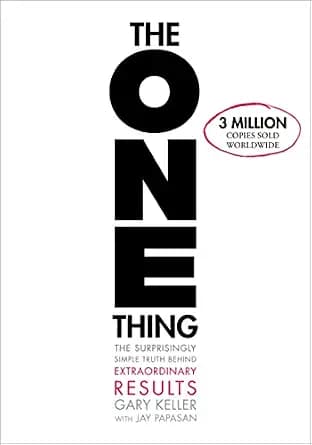
The ONE Thing: The Surprisingly Simple Truth About Extraordinary Results
Description
The ONE Thing earns an average rating of 4.6 from over 21,000 reviews, indicating very high overall user satisfaction. While feedback is generally positive, the analysis shows that individual ratings and review content are not perfectly aligned, and some feedback lacks detailed, practical insights. The language tone in the reviews appears authentic and not overly promotional. Overall, the product is well-received, but potential buyers should note that the review consensus is slightly less reliable than the high rating suggests.
One less thing to search
Before you buy: quick questions
Is this book just a rehash of the 80/20 rule, or does it offer something new?
Great question. The book is heavily inspired by the 80/20 principle (and the author acknowledges this), but it goes a step further by offering a specific framework called "The Focusing Question." Instead of just saying "focus on the vital few," it teaches you how to identify your ONE domino that will knock down everything else. Think of it as the 80/20 rule with a motivational engine and a practical time-blocking system attached. That said, if you're already fluent in Pareto principles, you might find the core idea familiar—but most readers still find the execution framework valuable. ---
Does this book actually work for people with chaotic schedules, like parents or shift workers?
This is a common concern we hear on Reddit and TikTok. The honest answer: it depends on your flexibility. The book's ideal user has some control over their calendar. If you can't protect a 4-hour block in the morning due to childcare or a non-standard work schedule, the time-blocking advice may feel frustratingly out of reach. However, many parents and shift workers still report success by adapting the "one thing" concept to micro-sessions—finding 30 minutes of focused time instead of 4 hours. The philosophy scales down, just not as elegantly as it scales up for knowledge workers. ---
How is this different from *Atomic Habits* or *Deep Work*? Should I buy it if I already own those?
Think of them as complementary tools in your productivity toolkit, not competitors. *Atomic Habits* teaches you *how* to build systems for continuous small improvements. *Deep Work* shows you *how* to concentrate intensely. *The ONE Thing* asks *what* you should concentrate on in the first place. Many readers own all three and use them for different purposes. If you already know what your top priority is, you might benefit more from *Deep Work*. If you feel scattered and need help identifying your north star, *The ONE Thing* is your starting point. ---
I've heard this book is repetitive. Is it worth the full read, or should I get a summary?
Valid concern. The book does have a reputation for repeating its core message across chapters. Many reviewers on Goodreads and YouTube note they could have absorbed the key ideas in a 20-minute read. That said, the repetition is intentional—it's designed to rewire how you think about prioritization. If you're a "just tell me the steps" person, a summary (like on Blinkist) will give you 80% of the value. If you need emotional motivation and repeated reminders to change a long-standing habit of multitasking, the full book's pacing may work in your favor. ---
What's the biggest risk if I buy this book—what do people regret most?
The most common regret we see in honest reviews isn't the money—it's the time. Specifically, the disappointment that comes from expecting a complete productivity system and receiving a mindset philosophy. Some buyers feel the title overpromises ("extraordinary results") and under-delivers on actionable steps. If you already have a strong productivity system and are looking for a tactical upgrade, this likely isn't it. But if you feel overwhelmed by too many priorities and need a clear lens for decision-making, the regret rate is very low—most people report their only regret is not finding it sooner.
Answers are limited to the manufacturer's listing and the reviews we analysed. Questions those sources cannot support are not answered here.
Transparent by design