What people like
Stable high-refresh signal conversion
Several reviewers report stable 4K high-refresh output with HDR and VRR from DisplayPort graphics cards to HDMI displays, with no flickering, black screens or dropouts.
Our buying verdict
Works well for many Nvidia setups at high refresh rates, but some users report failures and no AMD VRR support.
Connecting a DisplayPort-equipped Nvidia PC or laptop to an HDMI monitor or TV at high resolution and refresh rate, including HDR and VRR.
Buyers using AMD graphics cards who need VRR or FreeSync, or setups with tight, recessed HDMI ports where bulky connectors may not fit.
The 30-second read
What people like
Several reviewers report stable 4K high-refresh output with HDR and VRR from DisplayPort graphics cards to HDMI displays, with no flickering, black screens or dropouts.
The main watch-out
A few reviewers report screen artifacts, static, flickering or no picture at all in their setups, suggesting occasional faulty units or compatibility problems.
Before you choose
The cable only converts DisplayPort output to an HDMI display, so it cannot connect an HDMI source to a DisplayPort screen and does not support AMD FreeSync.
Description
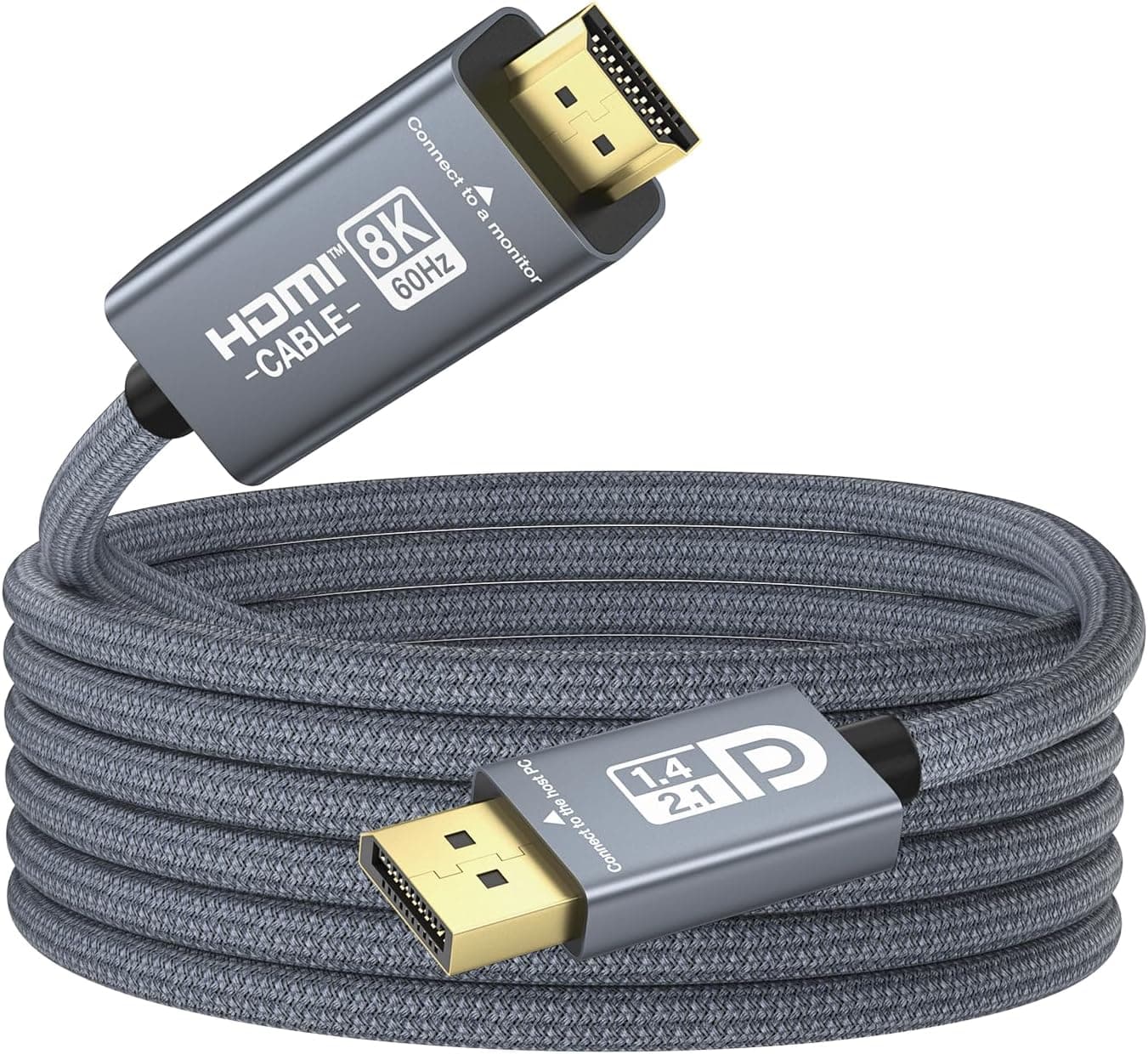
[Leading Active G-SYNC VRR Converter] *If you encounter compatibility issues, please contact us for the latest firmware.* This is an active, unidirectional DisplayPort 1.4a/2.1 to HDMI 2.1 cable specially designed to support nVidia G-SYNC Variable Refresh Rate (VRR). It ensures a smooth gaming experience by eliminating screen tearing and jerking when connecting Windows PC GPUs to HDMI 2.1 displays. *Note: NOT suitable for PS5/Xbox/switch/Docking Station/AMD * [8K@60Hz & 4K@144Hz] Provides ultra-high resolutions up to 8K@60Hz and 4K@144Hz/120Hz. Backwards compatible with 2K@360Hz/240Hz/144Hz/120Hz. Ideal for high refresh rate gaming on premium OLED TVs and monitors. Please make sure your monitor's firmware and the drivers of your graphics card are up to date. Due to driver issues, some functions may not be available. [Optimized for New NVIDIA GPUs] Wide compatibility with high-end graphics cards from NVIDIA, including the GeForce RTX 50 series such as RTX 5090/5080/5070/5060 as well as the RTX 40 series such as RTX 4090/4080/4070/4060. Ensures stable signal transmission via DisplayPort 1.4a/2.1. We recommend using the Windows 11 x64 operating system as well as the latest drivers. [Advanced Video Features] Supports high-bandwidth features such as Dynamic HDR, Dolby Vision, HDCP 2.3 copy protection and Display Stream Compression (DSC) 1.2a for uncompromising image quality. [Important Unidirectional Construction] This cable only supports signal conversion from a DisplayPort source to an HDMI display. It is not bi-directional. NOT compatible with HDMI source devices such as PS5, PS4 or Xbox. Does not support AMD FreeSync VRR. [Customer Service] We offer 18 months support. Please contact us at any time if you have any product problems. We will offer you a solution within 24 hours on business days.
Check the evidence
Included does not mean verified authentic. Flagged does not mean proven fake. These are analytical classifications.
Showing 3 illustrative excerpts, not the complete review set.
As good as most DP 1.4 to HDMI 2.1 w/ long list of compatible GPUs & Display protocols, recommended
“Ordered via vine, Note: Product arrives in a brown recyclable resealable bag/packet with recycle logo, and it has some branding, certification etc on it - this is not the Amazon box but the product box, it arrives very well presented, with velcro tie and clear plastic protective covers on each male plug. I had a Displayport to HDMI adapter messing about so I needing to buy or order some alternatives for diagnostics and to if necessary replace it, and this whilst it's generic virtually does so same only its in full cable form instead of an adapter + HDMI cable. If I were choosing, I personally would have got for a non nylon braided even a basic black PVC jacket as long as AWG/gauge is good, but that's entirely subjective and my own opinion, the colour and braiding some may appreciate as making the cable more durable, even though at 2M or any length these are typically static connections so it doesn't really make a difference. Nonetheless bylon braiding has become the standard that many expect these says, but it's absolutely fine. Similarly, it has typical graphite "peripheral grey" HDMI and DP actually 1.4a male aluminium housing, there is a nice velcro cable tie, each plug is of high quality either gold or nickel plated - with some contrasting white DP logo 1.4/2.1 and HDMI Cable - additionally there are "connect to host" and connect to monitor indicators in the same white laser printed with small arrows which will be helpful for some as it's unidirectional. Also the entire cable from DP to HDMI plug is well constructed, it feels well made, it's rigid due to the nylon braiding but not an issue, the cable is reinforced as cable meets each plug. Performance wise although HDMI 2.1 is 48Gbps the quite typical Display Port 1.4a caps out at 32.4Gbs, but that already supports Dolby Vision Support, G-SYNC VRR, RGB DCI-P3, and it markets itself as "a Active G-SYNC VRR Converter" which sounds good, it also mentions a number of Nvidia RTX cards specifically that it supports, although I'm using a humble AMD 780M by comparison, it should work with Win 11 both Nvidia and AMD unless it's a card+display that exceeds DP 1.4 bandwidth like Thunderbolt5 and 16K displays etc. Otherwise this is just like most DP 1.4 to HDMI cables/adapters with versatile applications with most not needing higher than DP 1.4, DP 2.0/2.1 which are far less numerous in these cables/adapters anyway and I'd expect to pay a fair bit more for those. So resolution and refresh wise it's "8K@60Hz & 4K@144Hz - Provides ultra-high resolutions up to 8K@60Hz and 4K@144Hz/120Hz. Backwards compatible with 2K@360Hz/240Hz/144Hz/120Hz." It also says it is optimised specifically for the mentioned high-end discrete NVidia cards which I do not doubt, including supports high-bandwidth features such as Dynamic HDR, Dolby Vision, HDCP 2.3 copy protection and Display Stream Compression (DSC) 1.2a. However whether these are actually some unique chip adaptation, or just the same as many or most DP 1.4 to HDMI cables I'm not sure, it also says "The worlds' first NVidia G-sync VRR adapter if you have RTX 40/50 series, but doesn't support AMD Freesync. Whilst I don't game or have those GPU's to validate, ULT-WIIQ appears to be a somewhat generic but established brand, I can see a number of cables and adapters in their web store, I'd be surprised if this was the worlds' 1st literally, their are larger peripheral brands I know of. So it's great that the product is specific on the GPU's etc it supports quite specifically however having reviewed a number of DP to HDMI's I think this is largely the support you'd find on most cable/adapters of identical protocol, although not all are created equally in terms of the chips within but by now you can buy 2M cable like this for not a huge sum and you'd have dozens to choose from. When I connected it from my PC's DP 1.4 out to my Monitors HDMI in it was only a 27" Philips QHD so well within the cables capabilities but I do have other 8K@60hz even 16K HDMI Cables with 96Gbps Ultra High Speed HDMI 2.2, and of course several Thunderbolt 4/5 these cables have become cheaper and more accessible compared to a few years ago. Value for money wise, ordered at £25.99 now with a voucher price of £22.09, I do think you could easily find 2M alternatives a bit cheaper, although if you are using high-end monitors, projectors, GPU's somebody like me who does no gaming using this on a Radeon 780M with up to 16GB DDR5 although I do have Oculink, this cable and its protocols many of them are designed for displays and GPUs and gaming or other usage far higher than mine. So I could probably get away with spending a bit less for virtually the same connectivity and compatibility - however if you do have the high-end displays and GPU's then it's worth checking that it supports the display protocol and version you need, and this is a DisplayPort 1.4a, DP 2.1/2.1b exists for even higher 16K and 80Gbps but they're far less numerous and I'd expect to pay higher. DP 1.4 to HDMI 2.1 is still by far the most common in terms of cables, adapters and protocol and have 3x DP 1.4 to HDMI 2.1 cables/adapters at least, and this was literally plug and play it fixed my seemingly defective adapter from a larger well known brand instantly. I can't find any non subjective faults with the cable and product as a whole it even comes with essentially a support/warranty card, only I think that like the voucher price for a 2M length somewhere closer to £20 would be more competitive, and the market sector is competitive. But mentioning all supported protocols is usually a sign of good quality as lesser alternatives exist, these are only as good as the mini-conversion chips within that also determine support. So I'm giving this a respectable 4/5 stars, only as some of the protocols in 2026 are more often likely to come natively on DP 1.4 to HDMI even generic brands, the "worlds first cable to support Nvidia G-sync VRR" I don't have the GPU or monitor to even test but I think might be overstating it somewhat, however there's no doubt this is a high quality with maximum support and compatibility 2M of DP to 1.4a to a HDMI 2.1. Gold plated connectors, aluminium housing, nylon coated is pretty standard. 15,000+ bending cycles I personally find a bit unnecessary in a display cable, but it'd durability I guess.”
Signals matched: Specific detail: entity, process · Reads as an authentic voice
Hochwertige Verarbeitung & perfektes Bild – Audio-Test leider nicht möglich
“Ich habe diesen aktiven DisplayPort-2.1-auf-HDMI-2.1-Adapter bestellt, um meinen Mini-PC an meinen TV anzuschließen. Der Hintergrund war, dass mein HDMI-Anschluss am PC kein Audio ausgab – laut verschiedener Quellen hätte der Displayport das Problem beheben sollen. Was ich testen konnte: Das Bild Der Adapter macht optisch und technisch einen hervorragenden Eindruck. Das Bild wurde sofort und ohne Verzögerung auf meinen TV übertragen. Die Bildqualität war gestochen scharf, und es gab keinerlei Flackern oder Aussetzer. Wenn man bedenkt, dass hier Auflösungen bis zu 8K@60Hz und 4K@144Hz möglich sind (was für aktuelle High-End-GPUs wie die RTX 50er-Serie gedacht ist), läuft die Übertragung bei mir im heimischen Setup absolut rund. Die große Einschränkung: Der Audio-Test Leider konnte ich die von mir erhoffte Audio-Übertragung über den Displayport nicht testen, da sich herausstellte, dass mein Mini-PC grundsätzlich kein Audiosignal über den DisplayPort-Ausgang liefert (unabhängig vom Adapter). Das Problem lag also an meiner Hardware und nicht an diesem Produkt. Ich kann daher leider nicht beurteilen, ob der Adapter Audiosignale zuverlässig durchschleift, aber laut Spezifikation ist er dafür eigentlich ausgelegt. Verarbeitung: Absolut top! Was mich wirklich positiv überrascht hat, ist die hochwertige Bauweise: Material: Sowohl der DisplayPort-Stecker als auch das HDMI-Buchsengehäuse sind aus robustem Metall gefertigt. Das fühlt sich sehr wertig und langlebig an. Kabel: Das Kabel selbst ist mit einem Textilgeflecht ummantelt und hat einen Durchmesser von 6,5 mm – das ist schön dick und schützt vor Knicken. Maße: Der Stecker ist mit ca. 8,8x19,4x30 mm sehr kompakt, die HDMI-Buchse mit 12x21x45 mm etwas klobiger, aber das ist bei aktiven Adaptern (mit integrierter Elektronik) völlig normal. Gewicht: Mit 35 Gramm liegt er gut in der Hand, ohne zu schwer zu sein. Preis-Leistung Für 16,99 € erhält man hier meiner Meinung nach ein sehr gutes Preis-Leistungs-Verhältnis. Vergleichbare aktive Adapter mit VRR- und G-SYNC-Unterstützung kosten oft deutlich mehr. Die Unterstützung für Dolby Vision, HDCP 2.3 und DSC 1.2a sind tolle Extras, die den Adapter zukunftssicher machen. Wichtig zu beachten: Wie in der Produktbeschreibung klar erwähnt, handelt es sich um einen unidirektionalen Adapter (nur DP auf HDMI). Er funktioniert also nicht mit Spielkonsolen wie der PS5 oder Xbox, und AMD FreeSync wird ebenfalls nicht unterstützt. Das sollte man vor dem Kauf unbedingt beachten. Fazit: Wer einen zuverlässigen, hochwertig verarbeiteten Adapter sucht, um einen Windows-PC mit einer Nvidia-Grafikkarte (ab RTX 40-Serie) an einen HDMI-fähigen Monitor oder TV anzuschließen, macht hier nichts falsch. Das Bild ist perfekt. Die fehlende Möglichkeit, das Audio zu testen, ist schade – aber dafür kann der Adapter nichts. Ich würde ihn auf jeden Fall weiterempfehlen, da die Verarbeitung und die Bildqualität überzeugen.”
Signals matched: Specific detail: scenario, process · Reads as an authentic voice
Zuverlässige Verbindung zwischen PC und HDMI-Monitor – unkompliziert und vielseitig einsetzbar
“Ich habe dieses Kabel getestet, da ich eine Verbindung vom PC (DisplayPort-Ausgang) zum Zweitmonitor (HDMI-Eingang) für meinen Office-PC benötigt habe. Anwendung und Einsatzmöglichkeiten Das Kabel wird direkt zwischen dem DisplayPort-Ausgang des Computers und dem HDMI-Eingang des Anzeigegeräts angeschlossen. Auch für die Verwendung eines zweiten Monitors kann das Kabel eine sinnvolle Ergänzung sein. Dadurch lässt sich beispielsweise mehr Platz für mehrere geöffnete Anwendungen schaffen oder der Bildschirm eines Computers auf einem Fernseher darstellen. Die Verbindung erfolgt ohne eine aufwendige Installation zusätzlicher Software, sofern die angeschlossenen Geräte die benötigten Funktionen unterstützen. Bild- und Tonübertragung Bei einem DisplayPort-auf-HDMI-Kabel stehen eine zuverlässige digitale Signalübertragung und eine unkomplizierte Verbindung im Vordergrund. Die tatsächliche Bildqualität hängt dabei nicht nur vom Kabel, sondern auch von der Grafikkarte, dem Monitor und den jeweils unterstützten Auflösungen und Bildwiederholraten ab. Neben dem Videosignal ist auch die digitale Audioübertragung möglich. Das ist beispielsweise praktisch, wenn der Ton über die Lautsprecher eines Fernsehers oder eines entsprechend ausgestatteten Monitors ausgegeben werden soll. Ich meinem Fall benötige lediglich das Videosignal, da ich am PC keine monitorinternen Lautsprecher nutze. Verarbeitung und Alltagstauglichkeit Bei einem Verbindungskabel dieser Art sind vor allem eine saubere Verarbeitung, passgenaue Stecker und eine zuverlässige Verbindung wichtig. Das Kabel lässt sich ohne großen Aufwand anschließen und glänzt mit einer stabilen Verbindung zwischen den Geräten. Die Steckverbindungen halten stabil und zuverlässig. Bei mehreren Rütteltests ist die Signalübertragung stabil geblieben, ohne irgendwelche Aussetzer. Wichtiger Hinweis zur Kompatibilität Vor dem Kauf sollte unbedingt auf die Signalrichtung geachtet werden: Ein DisplayPort-auf-HDMI-Kabel ist grundsätzlich für die Verbindung von einer DisplayPort-Quelle zu einem HDMI-Anzeigegerät vorgesehen. Es ist nicht automatisch dafür geeignet, ein HDMI-Ausgangssignal in einen DisplayPort-Eingang umzuwandeln.”
Signals matched: Specific detail: scenario, entity · Reads as an authentic voice
One less thing to search
No — and this is the most important thing to check before buying. This is a **unidirectional DisplayPort-to-HDMI** cable, meaning the signal only flows from a DisplayPort source (like your PC's GPU) to an HDMI display. It won't work with HDMI-output devices such as PS5, PS4, Xbox, Switch, or docking stations. Many shoppers on Reddit and TikTok mention getting caught out by this, so if you're a console gamer, a standard HDMI 2.1 cable is what you need.
Unfortunately, no. This cable is specifically engineered for **NVIDIA G-SYNC Variable Refresh Rate** and does not support AMD FreeSync. It's optimized for RTX 40- and 50-series cards (4090/4080/4070 and 5090/5080/5070, etc.) running Windows 11 with the latest drivers. AMD users should look for a FreeSync-certified DP-to-HDMI adapter instead.
Yes, provided your entire setup supports it. The cable handles up to **8K@60Hz and 4K@144Hz/120Hz** (and 2K@360Hz for competitive gaming), but high-bandwidth modes rely on Display Stream Compression (DSC) and a compatible GPU, monitor, and firmware. A few users report flickering at the highest refresh rates until they update their GPU drivers and monitor firmware — so make sure both are current before judging performance. If you hit issues, the seller offers firmware updates via support.
Some warmth is expected because this is an **active cable** with a built-in converter chip, and it does prefer a clean, direct connection between your GPU and display. It's not a plug-and-play cable for every port combination, so avoid unnecessary adapters or hubs in the chain. If you experience signal drops or black screens, contact support first — reviewers consistently praise their fast, 24-hour firmware help, and most issues are resolved with an update rather than a return.
You're covered by an **18-month support window**, and the seller responds within 24 hours on business days, so reach out before assuming it's faulty — many "dead" cables turn out to need a firmware or driver update. For the right buyer (NVIDIA RTX + HDMI 2.1 OLED/monitor), it's excellent value compared to pricier active converters and delivers the smooth, tear-free G-SYNC experience enthusiasts rave about. Just confirm your GPU, display, and direction of signal **before** ordering to avoid the most common regret.
Answers are limited to the manufacturer's listing and the reviews we analysed. Questions those sources cannot support are not answered here.
Transparent by design