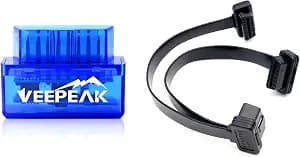
Veepeak Mini Bluetooth OBD II Scanner for Android (Incompatible with iOS) and OBD2 Splitter 1 to 2 Y Adapter 2-Way OBD Extension Cable(1FT/30CM) 1x Male Plug to 2X Female Connectors
Description
1.The vehicle in your garage can be as smart as your phone. Turn your Bluetooth-enabled Android phone or tablet into a sophisticated diagnostic scan tool and real-time parameter monitor. The VP11 directly plugs into your vehicle's OBDII port and connects to an OBD II App on your Android device via Bluetooth. Whenever you have a check engine light on or want to see how your vehicle is performing, this little gadget will help you better understand your vehicle. 2. Connect two OBD2 devices at the same time. Reduce the wear and tear on the OBD connector of your vehicle, and make it easy to access by using a flat flexible OBD 1x2 extension cable with 90° angled connectors and put your OBD devices exactly where you want it. It's a perfect solution for multiple OBD2 devices and hard to reach vehicle OBD2 connectors.
One less thing to search
Before you buy: quick questions
I have an iPhone. Will this work for me?
No, this specific Veepeak Mini scanner is not compatible with iOS devices (iPhones or iPads). It uses a classic Bluetooth connection, which Apple devices do not support for OBD2 communication. Many frustrated reviews come from users who missed this key detail. If you're an iPhone user, you'll need a scanner that uses Bluetooth Low Energy (BLE), such as the Veepeak OBDCheck BLE.
What do I need to get started, and is there a good free app?
You'll need an Android phone/tablet with Bluetooth 2.0 or higher. The scanner itself doesn't come with software. After plugging it in, you pair it via your phone's Bluetooth settings (PIN is usually 1234 or 0000), then use a third-party app. A popular and reliable free choice is "Torque Lite". Many YouTube tutorials feature this exact combo, noting it's perfect for reading and clearing basic engine codes.
How is the build quality, especially of the splitter cable?
The mini scanner is generally praised for being small and sturdy enough for occasional use. The included 1-foot OBD2 Y-splitter, however, is a lighter-duty component. As noted in some reviews, it's made of thinner plastic and is intended for low-profile, semi-permanent installations (like powering a dash cam) rather than frequent plugging/unplugging. For heavy daily use, a more robust splitter might be recommended.
Will this work with my specific car?
It works with most gasoline cars sold in the USA from 1996 onward, and most diesel vehicles from 2004 onward (OBD2 standard). However, a small number of users with very old (early 2000s) or certain imported models have reported compatibility issues. It reads standard OBD2 codes (like P0xxx) well but does not access manufacturer-specific proprietary codes. Checking your vehicle's manual for OBD2 compliance is always a good step.
Who is this product best suited for?
This is an excellent, budget-friendly toolkit for Android users who want to: * Read and clear a basic check engine light. * Have a compact scanner to leave plugged in. * Use the splitter to share the OBD2 port with another device (like a GPS tracker). It's ideal for DIYers, students, or rideshare drivers. If you need advanced diagnostics, live data graphing, or iPhone compatibility, you may want to consider a different model.
Answers are limited to the manufacturer's listing and the reviews we analysed. Questions those sources cannot support are not answered here.
Transparent by design