What people like
Great taste and effective filtration
Many reviewers report the water tastes great and that the included tester shows 0 ppm after filtering, confirming the filter removes contaminants. Some also mention good value and easy use.
The 30-second read
What people like
Many reviewers report the water tastes great and that the included tester shows 0 ppm after filtering, confirming the filter removes contaminants. Some also mention good value and easy use.
The main watch-out
Some users report that filters can develop a sour taste or stop reducing TDS after about a month, and that filters may not last as long as expected, leading to higher costs.
Before you choose
The filtration process can be slow, and the lower dispenser may develop leaks over time, so consider your patience and placement needs.
Your use case first
64 of 280 mentions describe a negative experience (23%).
61 of 208 mentions describe a negative experience (29%).
22 of 207 mentions describe a negative experience (11%).
315 of 877 mentions describe a negative experience (36%).
252 of 602 mentions describe a negative experience (42%).
255 of 425 mentions describe a negative experience (60%).
287 of 347 mentions describe a negative experience (83%).
220 of 235 mentions describe a negative experience (94%).
One review can mention several topics. Percentages describe the reviews we analysed, not all buyers or the product's overall failure rate.
Check the evidence
Included does not mean verified authentic. Flagged does not mean proven fake. These are analytical classifications.
Showing 3 illustrative excerpts, not the complete review set.
How to extend life of filters.
“UPDATE 4 (final): I could not get these filters to last longer than about 30% by using the prior (old) filter to pre-filter to a new one. So I bought a reverse osmosis system ($200) which gets TDS down to 18 ppm and other reported this same amount (about 225 ppm TDS input). But my daughter still said it tasted a little bad. So I'm using a zero filter to filter the output from the reverse osmosis and it's 0 ppm. The strange thing is that I'm using an old zero water filter that was starting to show 5 ppm. It went to 0 ppm after a few days and for I think 2 months now, it's output is still 0 ppm. (about 0.5 gallons per day) UPDATE: After starting this, I used the TDS meter to check the output of the top filter once a day. It slowly raised to 6 and then I stopped checking. A week later (about 1 week after I started doing it) the TDS showed 250 while the tap water was 200. It also tasted bad (out of the top filter, not the bottom). So it seem to have "breakthrough" a lot worse than I expected [see up date 3 below]. The day before I squeezed the sides of the top filter to get air out and I wonder if that let gunk that had been caught over the previous several weeks and in the top part of the filter had got around the sand by flowing down the sides. UPDATE 2: I broke the used filter apart to try to see why it started having TDS as high as the tap water. Inside, on the first 1/3 or 1/4 is an activated carbon layer. The rest is "sand". I didn't see any other stages, just the sand that looks interesting and weird when light reflects off of it. There's a thin white "filter" at the bottom, but that's just keeping the sand from coming out. I looked at it under a microscope & knew what it is. I visited a 3M plant in Alabama where they made it & took home a sample. They're really small, very smooth, hollow glass beads that they sprinkle on paints to make things like traffic signs reflective to on-coming lights. There's only a certain angle that solid rain drops reflect light to make a rainbow. The optics of a hollow sphere reflect back to the light. They may use it as a filter because the smooth round shape is easy to clean (if not bought perfectly clean form the manufacturing process), and no super-fine particles are in it like natural sand, although the diameter varies a lot to pretty small which helps in compacting & filtering. It's neat stuff. UPDATE 3: Seeing what it is, I rinsed the old "sand" in a pan with clean water from the new filter. The TDS of the rinse went from about 100 ppm to 0 ppm in 6 rinses. I also tried soap and hot water. At first it seems to filter down to 20 ppm, but then in only 1 cycle of water it was up to 150 ppm, so the top 1/2 layer of activated carbon (and I think sand) that I had removed must have been doing a lot more. See image. After TDS meter says 4 ppm after a few weeks (250 ppm tap water) my daughter complains (she's super sensitive) that it's not perfect anymore. So to extend life of filter I move it to the top holder and put a new filter in bottom. Top drains into bottom so old filter pre-cleans before going to new filter, so it should last a LOT longer. I'm just now trying it, so I don't know but simple math says it should last at least 10x longer. It depends on what the "breakthrough profile" which depends on the concentration. For example, the output water of the top filter could suddenly jump from 6 ppm to be more like tap water. Or the small particles coming through the top should find it easier to make their way through the new filter, so it could make it through faster in the bottom. Then there's the "fishy smell" people talk about. If that's something in the filter form using it too long, then the top filter could start causing that and possibly it's something that the bottom filter can't filter out. But my impression is the the fishy smell was in the rest of the container and they just need to clean it, especially the valve. Maybe just run 1 part bleach to 10 parts water through it for a couple of minutes instead of trying to take it apart.”
Signals matched: Specific detail: quantity, process, comparison, entity · Mentions: filter life, taste, filter performance · Reads as an authentic voice
Hands down the best - This is the one you want. Stop thinking & BUY IT!
“This is hands down the best gravity fed water filter I have ever used. A Brita will not come close to the power of the Zero-water products. Zero-water filters do what they are meant to: they pull junk out of the tap water. A typical, cheaper water pitcher filter will remove some additives such as chlorine, but they will not come close to actually stripping the water down to 0 PPM. A Zero-water will do that. I have used a TDS meter on water that I have filtered with reverse osmosis units, whole house water filters, BRITA filters, Culligan, & various other brands. Some of these water filters actually raise the TDS (total dissolved solids) count of the water that they "filter." A water filter that raised TDS is not a water filter - It is junk marketed as a filter. Zero water strips the water down to 0 PPM. This is what you want with a water filter. The brand is so confident that they actually send out a TDS meter with your filter. I live in a heavily populated city and the water here is notorious for being full of junk like chlorine, algacide, cobalt, disinfectant byproducts, atrazine, and countless other nasty additives that do not belong in drinking water. When I test the tap water here it ranges anywhere from 190 to 210 depending on the day. After running the same tap water through my ZERO-Water filter it comes down to 0 PPM. No other water filter for under $100 comes close to being able to do this. DO NOT waste your money on a cheaper filter such as a WATER-DROP, Brita, etc. You are just throwing your money away. Spend a small amount more and buy a ZERO water. I am a huge fan of water distillation but distilled 1 gallon of tap water typically takes 3-5 hours depending on the water distiller. A Zero-Water filter is the next best thing to water distillation. Distillation is expensive (will notice a spike in your electrical bill) and time consuming. On days where I need clean water and do not have the time to wait for my distiller - I use the zero water filter. I also cook with water directly from the ZeroWater filter. Do not make soups or boil water with tap water - EVER. Clean it with a quality filter and you will feel the difference. I used to get chronic migraines. When I started drinking 0 PPM water (that I will sometimes remineralize with salt) the headaches went away almost immediately. I think many chronic health issues that people suffer with daily are a direct byproduct of consuming tap water that is loaded full of chemicals and additives. After getting my ZERO-Water filter - I will never get another brand of gravity fed filter. Zero Water for life!”
Signals matched: Specific detail: comparison, quantity, entity · Mentions: filter performance, water quality · Promotional-style language
I didn't know water could taste this good!
“CON: I followed the directions regarding running water over the water filter for 30 seconds prior to attaching it to the under side of the reservoir. I attached the filter, but man!!! The filter speed could use some revamping. It takes forever and a day for the water to pass through the filter into the dispenser. Hey Culligan man...if you read my review, please do something about this! That's why I knocked off one star. I would highly recommend refilling the upper water tray each time you dispense water into your drinking vessel. I think it has something to do with the laws of physics. I added water into the top reservoir while there was already filtered water in the dispenser. I waited quite a while, but the water didn't finish draining into the pitcher. So I picked up the top reservoir part and held it over the water and it finally began to drain into the dispenser. I repeated this step until the pitcher was full. I then lowered the top tray back down. There is only one small drain hole on the bottom of the filter. PRO: I'm kind of a water snob. I can tell the difference between tap and different water bottles like Dasani, Arrowhead, etc. I have a couple of favorites (psst...not Arrowhead 🤮). But, when my dispenser finally had enough water in it for me do dispense - - boy was I surprised! The water is delicious! It's hard to describe, but it tastes fresh and clean. Almost like distilled water. I have a feeling my coffee will taste even better now. Another thing is that it comes with a probe to test the water quality so you know when to change the filter. I tested it on tap water and it was 361. Then I tested water from a popular competitor that kind of rhymes with Greta and the number was 331. I tested it on this filter system and it registered all zeros, so this filter system works! Bottom line, if you don't mind a system that takes a very long time to filter, I highly recommend this one.”
Signals matched: Specific detail: process, comparison · Mentions: taste, ease of use, filter performance · Reads as an authentic voice
One less thing to search
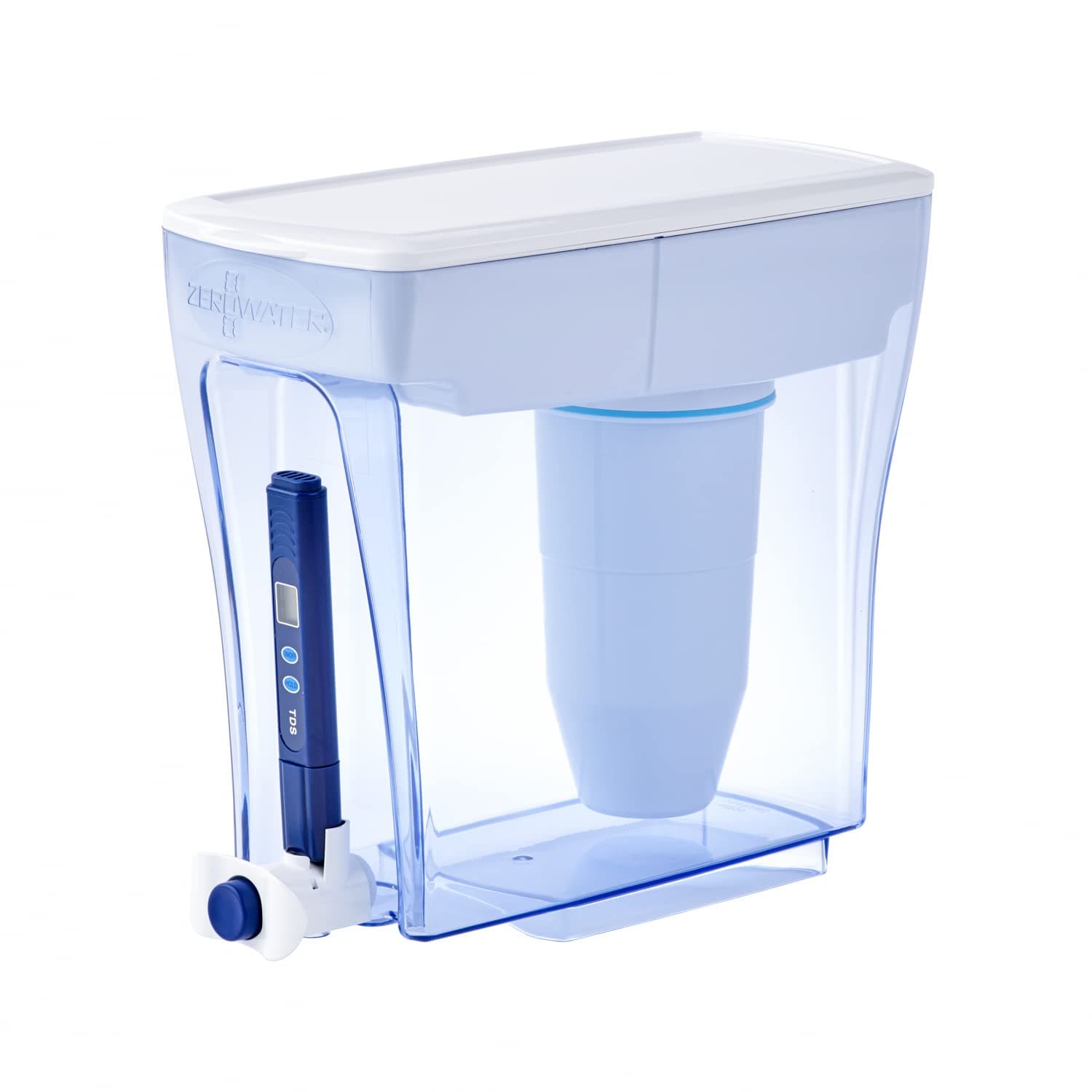
Reviewers report the tester working as expected, with one noting tap water at 115 ppm dropping to 000 after filtration, and another reporting tap water at 36 ppm versus 0 ppm filtered. The listing states the dispenser includes a TDS meter to check dissolved solids before dispensing or pouring.
One reviewer said they changed the filter only once over a 6-month period, at a reading of 4 ppm, even though the instructions say to wait until 6. The listing says the built-in TDS meter lets you always know when it is time to change your filter.
Multiple reviewers describe the water as tasting great with no taste after filtration, and one said they didn't know water could taste this good. However, one reviewer reported a sour taste developing after about a month of use.
Reviewers note the process is slow, with one saying it "takes forever and a day" for water to pass through the filter, though another said that knowing this beforehand lets you plan ahead. The listing notes the Ready-Pour technology lets you pour while the reservoir is still filtering.
The listing states the purchase includes a 20-cup dispenser, a 5-stage ion exchange filter, and a TDS meter, and that the filter is IAPMO certified to reduce PFOA/PFOS, lead, chromium, and mercury.
Answers are limited to the manufacturer's listing and the reviews we analysed. Questions those sources cannot support are not answered here.
Transparent by design