What people like
Reliable backup power for appliances
Several reviewers report the unit running refrigerators, freezers, and other appliances during outages, with some citing long runtimes and remaining charge.

Our buying verdict
Several reviewers report strong fridge and camping backup performance, but some units failed or shut down during firmware updates.
Buyers wanting a compact, quiet backup power station for refrigerators, camping, or small off-grid setups who can tolerate some reported reliability risk.
Buyers who need uninterrupted power for critical servers, security systems, or NAS devices, given a reported shutdown during firmware updates.
The 30-second read
What people like
Several reviewers report the unit running refrigerators, freezers, and other appliances during outages, with some citing long runtimes and remaining charge.
The main watch-out
One reviewer reports the S2000 completely shuts down power output during firmware updates in UPS mode, which is a serious risk for critical equipment.
Before you choose
Reviewers note solar charging takes about 8 hours with a 200W panel, and one mentions only 400W of solar input is allowed.
From a similar, more-reviewed product in this category: Jackery Explorer 300 Portable Power Station,292Wh
What people like
Several reviewers use it to charge phones, laptops, and CPAP machines, and value it as backup power during outages. It is described as compact, lightweight, and easy to carry.
The main watch-out
Several reviewers report fast battery drain, short runtimes, or units that stopped working, including some that failed after limited use. Others report charging problems or overheating.
Before you choose
Reviewers using it for CPAP report very different runtimes depending on humidifier and heated-hose use; some got only about four hours, while others got a full night with those features off.
High-volume review analysis
Five signals are scored from the collected reviews; every line shows the statistic that produced it.
Signals run from −1 to +1. See Methodology for what this analysis cannot detect.
Description
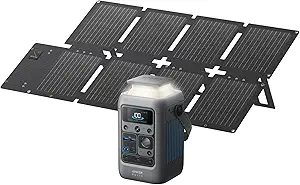
20% Longer Runtime 2 Peak Efficiency 3 Essential Backup 4 Power Output 5 400W Solar Input Previous page in 5 Years Next page 1 10 ms UPS 2 15-Year Lifespan 3 30 dB Quiet Power 4 Smart APP Control 5 Pays for itself Previous page Next page 1 Smaller and Lighter 2 Outlast Outdoor Adventure 3 Installation-Free 4 8 Ports 5 Specs FAQ Q1:How is the rated 35-hour fridge runtime measured? A: The 35-hour runtime is based on lab testing with a 700 L refrigerator at 77°F (25°C) ambient, 37°F (3°C) main compartment, and 0°F (-18°C) freezer. Actual runtime will vary depending on your refrigerator model, usage habits, and ambient temperature. Q2:How do I estimate the runtime for my refrigerator? A: Check your Energy Guide label for rated daily consumption (kWh / day), then use this formula: Runtime = Capacity (kWh) × Inverter Efficiency (0.9) ÷ Daily Energy Use (kWh / Day). E.g., (2kWh × 0.9) ÷ 1.1kWh / day ≈ 1.64 days (~ 39 hours). Q3:How do I make my Anker SOLIX S2000 run more quietly? A: To reduce fan noise, enable Silent Mode in the app and set the charging power to 600W or below. We also recommend updating Anker SOLIX S2000 to the latest firmware to ensure optimum performance. Q4:What devices can Anker SOLIX S2000 power? A: S2000 supports up to 1,500W of continuous output. If a red "OVERLOAD" indicator appears, disconnect the appliance immediately to clear the fault. Note: Some appliances, such as microwaves, may draw more power than their rated wattage. Q5: What are the functional limitations of different App connection methods? A: Without the App, you will not be able to modify any settings, nor update the firmware to fix bugs and access new features. To access the full range of features, the device must be connected to the App via Wi-Fi. Please note that you must register and log in to the App to enable the Wi-Fi connection. If you choose to connect via Bluetooth only, the following features will be unavailable: --Time-of-Use (TOU) Mode / Remote Control / Storm Guard / Custom Mode / Self-Consumption Mode / Historical Data. Cross Table Anker SOLIX S2000 Add to Cart S2000+400W Solar (New) Add to Cart Anker SOLIX C2000 Gen 2 Add to Cart Anker SOLIX C1000 Gen 2 Add to Cart Anker SOLIX S5000 Add to Cart S5000+400W Solar Panel Add to Cart Anker SOLIX F3000 Add to Cart Customer Reviews 4.7 out of 5 stars 527 4.7 out of 5 stars 527 4.7 out of 5 stars 756 4.6 out of 5 stars 1,794 5.0 out of 5 stars 4 5.0 out of 5 stars 4 4.4 out of 5 stars 263 Price $699.99$699.99 $1,199.99$1,199.99 $949.99$949.99 $529.99$529.99 $2,949.00$2,949.00 $3,561.00$3,561.00 $2,299.99$2,299.99 fridge (190W) Up to 35h Up to 35h Up to 32h Up to 14h Up to 86h Up to 86h Up to 42h Dimensions 8.19x11.1x12.7 in 8.19x11.1x12.7 in 18.1 × 9.8 × 10.1 in 15.12 x 8.19 x 9.61 in 15.4 x 10.6 x 22 in 15.4 x 10.6 x 22 in 25.98 × 11.61 × 14.76 in Weight 35.7lb 35.7lb+29.98 lb 41.7 lb 24.9 lb 96.8 Ib 96.8 Ib+35.1 lb 91.5lb+35.54 lb Cycle Life 10,000 Cycles to 60% Capacity 10,000 Cycles to 60% Capacity 4,000 Cycles 4,000 Cycles 10,000 Cycles 10,000 Cycles 4,000 Cycles to 80% Capacity Output 1500(3,000W Peak Output) 1500(3,000W Peak Output) 2400W (4,000W Peak Output) 2000W (3,000W Peak Output) 4500W(8000 Peak Outpu) 4500W(8000 Peak Outpu) 3072W (3,600W Peak Output) Solar Input 400W 400W 800W 600W 3000W max 3000W max 2400W UPS Switchover Time 10 ms 10 ms 10 ms 10 ms 10 ms 10 ms 20 ms 12V DC Port No No Yes Yes - - Yes Solar Panel Dimensions / 22.32"L × 38.70"W × 3.15 "H / / - 35.94"L x 26.89"W x 1.97"H 35.94"L x 26.89"W x 1.97"H Solar Panel Weight / 29.98 lb / / - 35.1 lb 35.1 lb Solar Panel Total Power Output / 400W / / / 400W 400W Solar Panel Waterproof Design / IP68 Waterproof Design / / IP68 Waterproof Design — IP68 Waterproof Design
Compare the trade-offs
A random selection of analyzed products from the same category. Different products are not necessarily interchangeable.

EF ECOFLOW DELTA 3 Max Portable Power Station, 2048Wh LFP Battery, 2400W
Anker SOLIX C300 DC Power Bank Station and 60W Solar Panel, 288Wh Portable Power Station, LiFePO4 Battery, 300W Solar Generator, for Outdoor, Camping, Traveling, and Emergencies

Jackery Explorer 2000 v2 Portable Power Station, 2042Wh, 2200W AC Output
Check the evidence
Included does not mean verified authentic. Flagged does not mean proven fake. These are analytical classifications.
Showing 3 illustrative excerpts, not the complete review set.
Anker S2000 - The best in 2 classes - Pros & Cons & Tips!
“This Anker S2000 may or not be an excellent choice for a power station. It depends on the person: Pros: This lithuim iron phosphate battery is even a better battery than lithuim ion. AC outlets in front and back. Anker is a good brand. Anker has a great free app to customize settings and to update firmware. Good overall quality: parts / assembly / quality control / saftey protection multiple systems. Overload protection - seems to kick in after about 20 seconds. Peak / surge 3000 watts (temporarily) -which is good because as an electric motor and/or compressor first spins up it may temporarily for between .5 second - 5 seconds peak/surge more than normal. Short circuit protection. Overheat protection. Good price. I purchased (2) for $1,379.99 U.S. dollars. (I could not find anything better at this price point.) This model has u.p.s. (so I can plug it in before a bad storm with possible power outage, instead of only afterwards.) There are many different ways to charge this unit (see details on Amazon.) The combination of good inverter and good standby/idle mode makes this model extremely efficient - which makes this units battery power last longer - the best in its class for a 2kWh power station. Also, the combination of compact and lightweight again makes this - S2000 - the best in its class for a 2kWh power station. (About the same weight as a 5 gallon / 20 liter container of gasoline.) Cons: No light. No expansion battery port. No 12V DC port (powered cigarette lighter port.) Only 1500 watts total sustained output power. Has a regular power cord plug not a flat plug. This power station is not waterproof (most power stations are not waterproof.) The so called handles I cannot easily grab on to. If I grab unit with one hand I will drop it. So I must use 2 hands to wrap some fingers underneath on both sides to grab under the lip on both sides, which makes it ok for around the house but, not good for other portability options. Overall I think it is the best unit for me. My plan is to use it primarily for in home power outages. For my fridge and some essentials - some examples: charging my phone & temporary running a led lamp or 2 for 1 - 2 hours per day & coffee maker & sump pump with extension cord (if it's raining) & wifi router (wireless internet) & garage door opener (with extension cord.) So, personally I bought 2: I can use them at different locations and/or for long power outages I can use one for fridge and one to charge offsite somewhere else - repeat every day. And I would recommend Anker S2000 for those that want to power a fridge and some essentials. However, if I was using a power station unit primary for rv / camper / travel vehicle / travel trailer / inside jobsite / inside worksite / long roadtrips / portability / camping (I would put it in my tent) - then at that point I would rather have: Anker C1000 gen1 - best for budget (1kWh) / Anker C1000 gen2 - different than gen1, in my opinion overall mostly better improved, but a little worse in some ways (1kWh) / Anker C2000 gen2 - best except more more expensive & more weight (2kWh - the battery power will last about twice as long as 1kWh before needing recharging.) All of these have more total watts sustained output power for cooking and more vs S2000. And also, overall more versatile vs S2000. If you bring it with you then your friends / family / coworkers will want to use it too. However, if I wanted a power station used primarily for outside worksite / outside jobsite / portability & not worrying about rain / primarily outdoor activitys - I would rather have a waterproof power station. Tips: This power station is NOT waterproof (most power stations are not waterproof.) So to avoid damage to unit and/or chemical fire from large battery getting wet: I would recommend using indoors inside home. Only for temporary outdoor use if no rain is possible. And I would use it away from water, away from sinks and I would put it in a spot where I would not accidentally spill a drink. Also, I would not plug in stuff to AC power outlets on this power station that have sensitive electronics (computers / anything with a computer example: a 'smart' fridge that tells you when you are low on milk) when charging this power station to a regular generator that produces dirty power. Most generators produce dirty power. (Dirty power is ok for a regular fridge.) The dirty power will be in pass through mode when traveling through as inverter works differently when power station is being charged. (DC power ports ok to be used anytime as DC is always clean.) Whatever works. Different things work for different people. Good luck and happy hunting!”
Signals matched: Specific detail: entity, comparison · Reads as an authentic voice
Rough shipping, but Anker support made it right
“I bought the Anker SOLIX S2000 and the box showed up in bad shape, beaten up on several sides and with an actual hole punched through it. When I pulled the power station out, I found scratch marks across the top and a fairly hard impact mark on the back panel. The unit powered on and worked normally, but my real concern was whether that impact would cause problems later and whether the warranty would still cover me, since none of the damage was my fault. I contacted Anker support and the experience completely changed my impression. They responded within a day, took the photos and details seriously, and offered two options. I could either accept a partial refund and keep the unit, or receive an advance replacement where they ship the new unit first so I am never without power. No pressure either way. I chose the partial refund because I needed the unit right away. They processed it immediately and, more importantly, gave me written confirmation that the 5 year warranty remains fully valid and that keeping the unit with the pre existing shipping damage will not void coverage. That was the part that actually mattered to me, and they documented it in their system under my order. As for the product itself, it charges and discharges exactly as expected and the capacity and output are solid for home backup. The cosmetic marks are purely visual and do not affect performance. My only real criticism is the packaging. For a unit this heavy and this expensive, the box offered very little protection. My advice to anyone buying this is to photograph the packaging and the unit the moment it arrives. That documentation is what made my case easy to resolve. Five stars for the product and for how Anker handled a bad delivery. The shipping damage was not their fault, and their support team did everything right.”
Signals matched: Specific detail: entity, process · Reads as an authentic voice
Solid, reliable power station!
“Solid, reliable power station! I've been using it for a couple of months, and it consistently performs well. It's super easy to use and is a great backup power supply. It runs quietly, and the display is easy to read. I either charge it with a normal home outlet or hook up Zoupw solar panels. One of the best features is that it has two plug-ins in the back, so you can plug things in on that side and not have cords in the front. Weight-wise, it's a little heavy but portable, and you'll need both hands to lift it. It weighs roughly the same as TWO 1-gallon jugs of milk. Solar panels connect easily with an XT60 cable. The app also works smoothly and is handy when you want to set it outside with solar panels and then be inside checking to see how much wattage is coming in from the solar panels and what the percentage is on the charge. As for powering a refrigerator, I've tested it several times, and it will run my 20-year-old refrigerator for about 24 hours every time. While it's not the 35 hours that I was hoping for, getting 24 hours works for me. With my fridge being 20 years old, I'm not sure how energy efficient it is, so that may be why I only get 24 hours instead of 35 hours. Overall, I'm very happy with this power station and recommend it. I've watched a lot of reviews about it and it always received many positive comments and reviews, so I felt confident when making the purchase. I've noticed the price varies from around $699 to $999. So, if you see it around the $699 price, I'd recommend buying it then, as I've not seen it go lower than that.”
Signals matched: Specific detail: process, scenario · Reads as an authentic voice
One less thing to search
That 35-hour figure comes from lab testing with a 700 L fridge at 77°F, so real-world results depend on your fridge's efficiency, how often the door opens, and ambient temperature. To estimate your own runtime, check your fridge's Energy Guide label and use: Capacity (kWh) × 0.9 ÷ Daily Energy Use (kWh/day). Many Reddit and YouTube users report 20–30 hours with older or garage fridges in warm conditions — still plenty for most outages, but worth calibrating expectations.
You can power devices without the app, but you'll lose settings adjustments, firmware updates, and features like Time-of-Use Mode, Storm Guard, and remote control. Full functionality requires Wi-Fi plus a registered account; Bluetooth-only connection still unlocks basic monitoring but drops TOU, remote control, custom modes, and historical data. If app-free operation matters to you, treat this as a "smart" device rather than a purely manual one — a point several TikTok reviewers flag upfront.
It delivers 1,500W continuous (3,000W peak), which covers most fridges, routers, lights, CPAP machines, and TVs comfortably. However, appliances with high startup surges — microwaves, compressors, and some power tools — can briefly exceed rated wattage and trigger the red OVERLOAD indicator. If that happens, unplug immediately to reset. For heavy surge loads, the C2000 Gen 2 (2,400W) is the better fit.
At low draw it's genuinely quiet, but fans ramp up during fast charging or high output — so the "30 dB" figure reflects ideal conditions, not peak load. To minimize noise, enable Silent Mode in the app and cap charging power at 600W or below, and keep firmware updated. Users who've tested it side-by-side with gas generators consistently call it dramatically quieter, even under load.
If your needs are fridge backup, CPAP, routers, and camping, the S2000 at $699.99 is the value pick — it offers a class-leading 10,000-cycle lifespan and weighs just 35.7 lb. Step up to the C2000 Gen 2 ($949.99) if you need 2,400W output and 800W solar input; choose the F3000 ($2,299.99) for whole-home or high-surge loads. Many buyers who skipped the 400W solar bundle later wished they'd included it, so factor panel cost in if off-grid recharge matters to you.
From a similar, more-reviewed product in this category: Jackery Explorer 300 Portable Power Station,292Wh
It's built for devices drawing under 300W total: laptops, phones, drones, cameras, fans, lights, a CPAP, and similar electronics. It will *not* run high-draw appliances like coffee makers, toasters, hair dryers, or full-size fridges — those need a larger unit such as the Explorer 1000 v2. A quick tip many reviewers share: check your device's wattage label before buying, and remember the 600W peak only covers brief startup surges, not continuous draw.
Use the formula **working time ≈ 292Wh × 0.85 ÷ your device's wattage**. A 60W laptop lasts roughly 4 hours; a 10W phone charge goes for many cycles. Keep in mind real-world runtime varies with temperature and device efficiency — several YouTube testers note heating devices drain it far faster than the math suggests, so plan conservatively for anything that generates heat.
Yes — the solar panel is **not included**. Via the 100W USB-C port (wall charger), it fully recharges in about 3 hours; a car port takes around 4 hours. For solar, a 100W Jackery panel reaches 80% in roughly 2.8 hours, while the compact 40W panel takes about 7.5 hours to hit 80%. Many campers recommend springing for the 100W panel upfront rather than the 40W, since the smaller one is best suited to topping up rather than full recharges.
At 7.5 lbs with an integrated top handle, it's about 17% lighter than the industry average for its capacity and easy to carry one-handed from car to campsite. That said, TikTok and Reddit users are candid: it's "portable" for car camping, overlanding, and short carries — not for multi-mile backcountry backpacking. If ultralight trekking is your goal, pair it with a small folding panel and treat it as basecamp power rather than pack weight.
The LiFePO4 battery is rated for 4,000+ charge cycles before dropping to 70% capacity — roughly 11+ years of regular use — which is a major step up from older lithium-ion models and a point buyers consistently praise. It operates from 5°F to 113°F. If you receive a defective unit (a small number of buyers report DOA outlets or fan noise), contact Jackery support for warranty service; most report polite resolution, though RMA turnaround can take a couple of weeks. Note that orders require a physical delivery address — PO Boxes aren't accepted — so double-check your shipping details at checkout.
Answers are limited to the manufacturer's listing and the reviews we analysed. Questions those sources cannot support are not answered here.