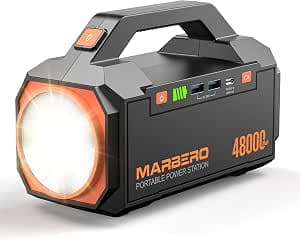
MARBERO Portable Charger Power Bank 48,000mAh Emergency 177.6Wh Portable Power Station, Fast Charging USB-C 60W PD Bright LED Flashlight & Panel for Travel, Camping, Business Trips & Outages
Descripción
Specifications of the Power Bank: Model Name: PL60DS Capacity: 177.6Wh, equivalent 48,000mAh/3.7V Fully Charged Time(Adapter): 15V/2A About 7hrs Fully Charged Time(PD): PD 60W About 4hrs USB C In: 5V/9V/12V/15V/20V/3A, 60W PD3.0, QC4.0+ Output Ports: 1*USB C: 5V/9V/12V/15V/20V/3A, 100W PD3.0, QC4.0+ 2*USB A: 5V/3A, 9V/2A, 12V/2A, 24W QC3.0 Bulb Type: 1*5W LED Flashlight 1*7.2W LED Light Panel Screen Indicator: LED Indicator Operation Temperature: 14℉-104℉ (-10℃-40℃) Storage Temperature: 14℉-113℉ (-10℃-45℃) Dimensions(L*W*H): 7.5*3.31*4.78 inches Weight: 2.71 lbs Package Includes: 1*MARBERO PL60DS Portable Power Bank 1*Adapter 15V/2A 1*User Manual
Compara las ventajas y desventajas
Productos similares, uno junto a otro
Una selección aleatoria de productos analizados de la misma categoría. Productos distintos no son necesariamente intercambiables.


Una cosa menos que buscar
Antes de comprar: preguntas rápidas
Is the 48,000mAh capacity realistic? Can I trust that number?
We understand the skepticism—many off-brand batteries inflate their specs. While the 48,000mAh figure refers to the internal cell rating (which calculates to 177.6Wh), real-world efficiency means you’ll get roughly 60–70% of that total output due to heat conversion. It will charge a modern smartphone roughly 8–10 times, which is consistent with a battery of this physical size and weight.
This is labeled as a "Power Station." Will it run my small appliances like a mini-fridge or a CPAP machine?
It is a high-capacity power bank, not a gas generator. It lacks AC outlets, but it does offer USB-A and USB-C ports. It *will* run 12V devices (like a car fridge) via a DC adapter, and 60W USB-C devices (like laptops and CPAP machines with a USB-C input). However, if you specifically need 120V AC outlets for a full-size refrigerator or heavy tools, you should look at a dedicated portable power station with inverters.
I’m planning a backpacking trip. Is this too heavy to carry around all day?
Given the high capacity, this unit is on the heavier side—think of it more like a "carry-in-a-duffel-bag" tool than a "slip-in-your-pocket" phone charger. It’s perfect for base camps, car camping, or office commutes in a tote bag. If air travel or minimal weight is your priority, note that the 177.6Wh rating is likely too high to bring on a plane without airline approval, and you’d be better off with a compact 20,000mAh model.
How long does it take to recharge the power bank itself from empty?
Patience is required here. With a standard 20W wall charger, a full recharge can take over 12 hours. However, if you use a high-wattage USB-C wall adapter (60W or higher), you can cut that time down to approximately 4–5 hours. We recommend leaving it plugged in overnight before a trip to ensure a full charge.
What kind of safety and after-sales support can I expect? What if the battery dies months later?
The unit includes circuit protection to prevent over-voltage, overheating, and short circuits. Regarding the "messaging" on the panels: if you feel the battery drains faster than expected, a full discharge and recharge cycle can often reset the battery management system (BMS). If you face genuine defects within the return window, the seller typically offers a free replacement. It is always good practice to test the unit fully when you first receive it to ensure all ports and the LED panel are working correctly.
De un producto similar con más reseñas en esta categoría: Jackery Explorer 300 Portable Power Station,292Wh
What can the Explorer 300 actually power — and what can't it?
It's built for devices drawing under 300W total: laptops, phones, drones, cameras, fans, lights, a CPAP, and similar electronics. It will *not* run high-draw appliances like coffee makers, toasters, hair dryers, or full-size fridges — those need a larger unit such as the Explorer 1000 v2. A quick tip many reviewers share: check your device's wattage label before buying, and remember the 600W peak only covers brief startup surges, not continuous draw.
How long will it run my device on a single charge?
Use the formula **working time ≈ 292Wh × 0.85 ÷ your device's wattage**. A 60W laptop lasts roughly 4 hours; a 10W phone charge goes for many cycles. Keep in mind real-world runtime varies with temperature and device efficiency — several YouTube testers note heating devices drain it far faster than the math suggests, so plan conservatively for anything that generates heat.
Do I need to buy a solar panel separately, and how fast does it recharge?
Yes — the solar panel is **not included**. Via the 100W USB-C port (wall charger), it fully recharges in about 3 hours; a car port takes around 4 hours. For solar, a 100W Jackery panel reaches 80% in roughly 2.8 hours, while the compact 40W panel takes about 7.5 hours to hit 80%. Many campers recommend springing for the 100W panel upfront rather than the 40W, since the smaller one is best suited to topping up rather than full recharges.
Is it really portable enough for hiking and camping?
At 7.5 lbs with an integrated top handle, it's about 17% lighter than the industry average for its capacity and easy to carry one-handed from car to campsite. That said, TikTok and Reddit users are candid: it's "portable" for car camping, overlanding, and short carries — not for multi-mile backcountry backpacking. If ultralight trekking is your goal, pair it with a small folding panel and treat it as basecamp power rather than pack weight.
How durable is it, and what if something goes wrong after purchase?
The LiFePO4 battery is rated for 4,000+ charge cycles before dropping to 70% capacity — roughly 11+ years of regular use — which is a major step up from older lithium-ion models and a point buyers consistently praise. It operates from 5°F to 113°F. If you receive a defective unit (a small number of buyers report DOA outlets or fan noise), contact Jackery support for warranty service; most report polite resolution, though RMA turnaround can take a couple of weeks. Note that orders require a physical delivery address — PO Boxes aren't accepted — so double-check your shipping details at checkout.
Las respuestas se limitan a la ficha del fabricante y a las reseñas que analizamos. Las preguntas que esas fuentes no puedan respaldar no se responden aquí.
Transparente por diseño