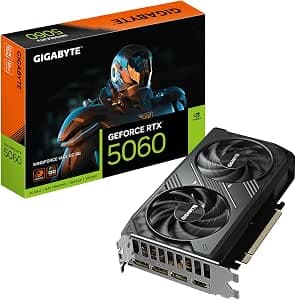
GIGABYTE GeForce RTX 5060 WINDFORCE MAX OC 8G Graphics Card, Cooling System, 8GB 128-bit GDDR7, PCIe 5.0, by NVIDIA, DisplayPort & HDMI - Video Output Interface, GV-N5060WF2MAX OC-8GD Video Card
Description
Ahead of its time, ahead of the game is the GIGABYTE GeForce RTX 5060 WINDFORCE MAX OC 8G Graphics Cards. Powered by NVIDIA's new RTX architecture, the GIGABYTE GeForce RTX 5060 WINDFORCE MAX OC 8G brings stunning visuals, amazingly fast frame rates, and AI acceleration to games and creative applications with its enhanced RT Cores and Tensor Cores, along with a staggering 8 GB of GDDR7 memory.
Compare the trade-offs
Similar products, side by side
A random selection of analyzed products from the same category. Different products are not necessarily interchangeable.

MOUGOL AMD Radeon RX 580 8GB Video Graphics Card with 256 Bit GDDR5 PCI Express x 16 3.0 Equipped with Freeze Dual Fans for Working Gaming GPU

RX 580 8GB Graphics Card, 2048SP GDDR5 256 Bit GPU, PCIE 3.0 Gaming Video Card, Dual Fans Cooling, Gaming Card with HDMI/DP/DVI Ports, Desktop Graphics, GPU Video Card for Desktop Computer

NVIDIA GeForce RTX 5080 Founders Edition
One less thing to search
Before you buy: quick questions
Is my power supply sufficient for this graphics card, and are there any common compatibility issues?
GIGABYTE recommends a 550W system power supply. However, based on user reports, we suggest a quality 600W-650W PSU for optimal stability, especially if you have an older unit or a power-hungry CPU. Some users with older motherboards also needed a firmware (VBIOS) update from GIGABYTE's website for full compatibility—it's a good first step if you experience crashes.
How does the 8GB of GDDR7 VRAM hold up for modern gaming, especially at 1440p?
For 1080p gaming, the 8GB VRAM is excellent. At 1440p, it handles most current games very well at high settings, but you may need to adjust texture quality in the most demanding future titles. As many reviewers note, this card is a value champion for rasterized performance. If your primary goal is maxing out ray-traced settings at 1440p, a card with more VRAM might be a better long-term fit.
I've seen the term "MAX OC" in the name. How significant is the factory overclock?
The "MAX OC" refers to GIGABYTE's factory-applied overclock, which offers a slight performance boost over NVIDIA's base specifications. It's designed for stability and reliability right out of the box. Tech-savvy users on forums often mention that while it's a solid baseline, the "MAX" shouldn't be interpreted as extreme overclocking headroom—it's a dependable, pre-tuned configuration for the average gamer.
What's the real-world noise and cooling performance like?
The WINDFORCE cooling system receives consistent praise for being quieter than many expect in a budget-friendly card. Under typical gaming load, the fans produce a manageable hum. A small number of users have reported coil whine (a high-pitched electronic buzz) during extreme loads, but this varies by unit and doesn't affect performance or longevity.
Who is this graphics card the best fit for, and who might want to consider an alternative?
This card is an ideal budget upgrade for gamers targeting smooth 1080p or very good 1440p performance without ray tracing. It's perfect for those moving from an RTX 2060/3060 or similar. If your top priorities are heavy ray tracing, ultra 1440p/4K gaming, or you have a very low-wattage PSU, you might consider alternatives like the RTX 5070 or AMD's RX 7700 XT. For pure rasterization performance at this price, however, the consensus is that it's very hard to beat.
From a similar, more-reviewed product in this category: ASUS GeForce GTX 1080 8GB ROG Strix Graphics Card (STRIX-GTX1080-A8G-GAMING)
What games and resolutions can this card handle?
Reviewers report it plays games at 1080p and 1440p at high frame rates, with one noting it handles 4K gaming and another saying 4K at maximum quality is difficult and runs hot. Multiple reviewers describe it as a beast that runs games on ultra settings without stuttering.
Is this card quiet during gaming?
Reviewers consistently describe it as quiet, with one noting low fan speeds and quiet operation at Full HD and WQHD, though the same reviewer says fan noise becomes quite loud at 4K maximum quality. The listing states Direct CU III cools efficiently and quietly.
Does this card have RGB lighting?
Yes, the listing states it has Aura RGB Lighting on the shroud and back plate, and reviewers mention the RGB features and controllable LEDs via Aura.
What power connectors does this card require?
The listing specifies 1 x 6-pin and 1 x 8-pin power connectors, and one reviewer notes they had to buy a new power supply because they lacked an 8-pin connector.
Is this card worth the price?
Reviewers widely consider it well worth the price, with several calling it worth every penny and one recommending buying it during sales, though another suggests going for the 1080 Ti if not on sale.
Answers are limited to the manufacturer's listing and the reviews we analysed. Questions those sources cannot support are not answered here.
Transparent by design