What people like
Strong coverage and fast, stable Wi-Fi
Several reviewers report strong signal, good range, and fast, stable connections, including in outbuildings and multi-device homes.
Our buying verdict
Delivers fast, wide coverage for many, but setup friction and no 6GHz band temper the fit.
Buyers wanting a fast, wide-coverage access point for home or small-office use who are comfortable with app-based setup and do not need a 6GHz band.
Buyers who need a 6GHz band or want setup that requires no networking knowledge and consistently simple configuration.
The 30-second read
What people like
Several reviewers report strong signal, good range, and fast, stable connections, including in outbuildings and multi-device homes.
The main watch-out
Several reviewers found setup confusing, with sparse instructions and a non-obvious default IP; some needed an hour or more to reach the portal.
Before you choose
The unit can be powered by PoE or the included DC adapter, but a PoE injector or switch is not included, so plan your power source.
From a similar, more-reviewed product in this category: TP-Link Deco X55 AX3000 WiFi 6 Mesh System, Deco X55(3-Pack)
What people like
Reviewers consistently praise the simple app-based setup and the reliable, fast Wi-Fi coverage it provides across large or multi-story homes.
The main watch-out
Some users report occasional connection drops between units and inconsistent speeds, and one review mentions receiving an opened, pre-configured product.
Before you choose
Placement matters for optimal coverage, and you may need a Cat6/Cat6a Ethernet cable to connect to your modem for full performance.
High-volume review analysis
Five signals are scored from the collected reviews; every line shows the statistic that produced it.
Signals run from −1 to +1. See Methodology for what this analysis cannot detect.
Description
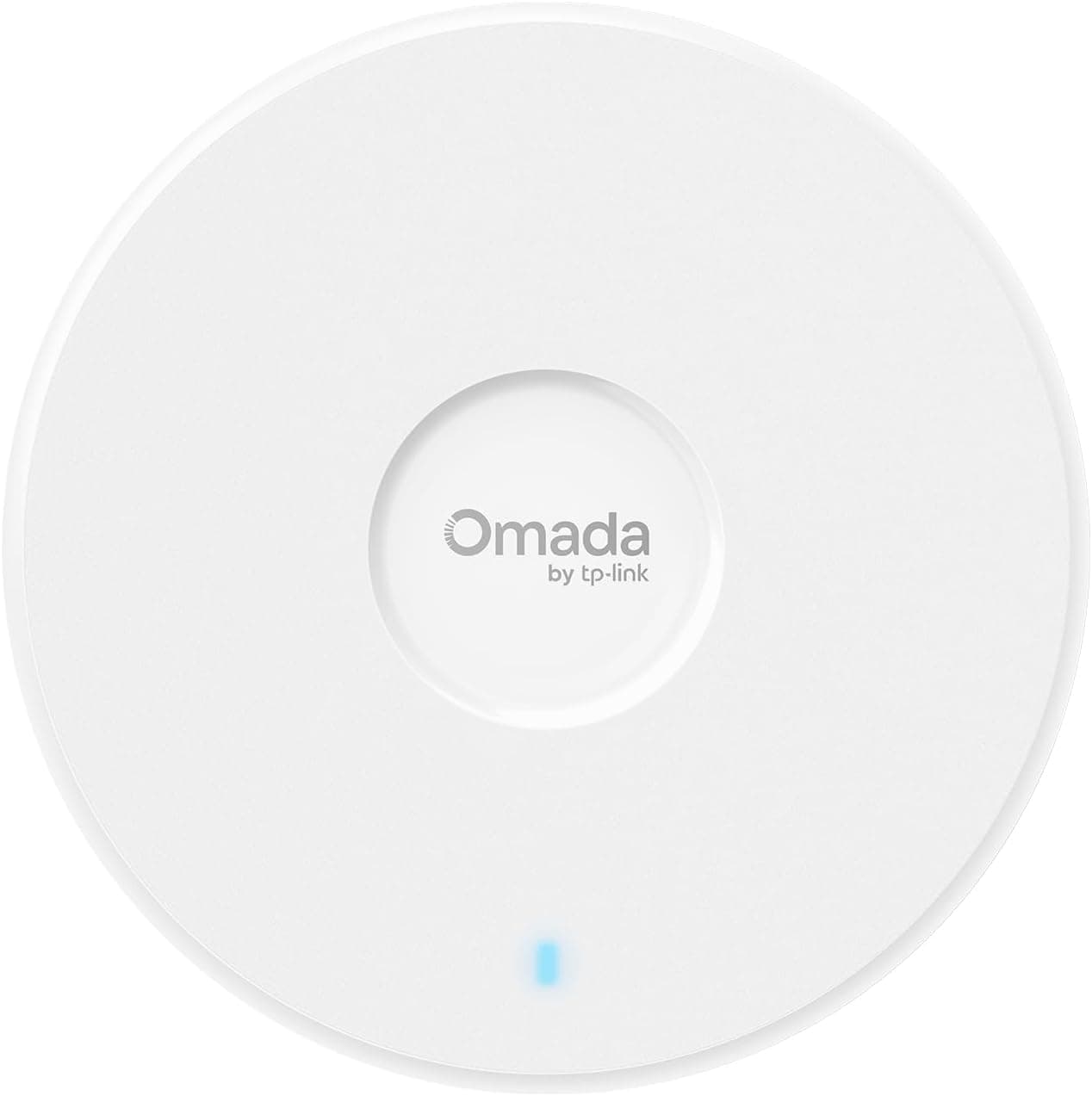
The TP-Link Omada EAP720 is a high-performance Wi-Fi 7 ceiling-mount access point, ideal for businesses. It delivers a total speed of up to 5.0 Gbps across dual bands (4324 Mbps on 5GHz, 688 Mbps on 2.4GHz) using advanced technologies like 4K-QAM and 240MHz bandwidth.Supporting over 250 concurrent devices, it ensures reliable connectivity in offices or public spaces. With a 2.5G Ethernet port, it boosts wired backhaul. Flexible deployment options include PoE (802.3at) or DC power, plus easy ceiling/wall mounting.It integrates seamlessly into Omada's SDN system, enabling mesh networking and centralized management via cloud, app, or local controllers. Enhanced security features like WPA3 and guest network isolation add protection. Perfect for scaling networks with consistent performance.
Compare the trade-offs
A random selection of analyzed products from the same category. Different products are not necessarily interchangeable.
Check the evidence
Included does not mean verified authentic. Flagged does not mean proven fake. These are analytical classifications.
Showing 3 illustrative excerpts, not the complete review set.
HUGE reliability upgrade over consumer mesh WiFi
“I recently installed the TP-Link EAP720 WiFi 7 access point as part of a home network upgrade, and I have been extremely happy with it. Before buying this, I was also looking at the Ubiquiti U7 Pro Max. I ended up choosing the TP-Link EAP720 because of the significant cost savings, and honestly, I am very glad I did. The performance and reliability have been excellent, and for my needs, it has been a fantastic value. I am using it with a TP-Link TL-SG3428 managed switch, a TP-Link TL-SG2210MP Managed PoE+ switch, and my home-built OPNsense router. I am also running the Omada Software Controller as a Docker container on my Dell PowerEdge T340 home server. Everything plays very nicely together. The TL-SG2210MP is powering the EAP720 over PoE+, which I love because I only had to run one network cable to the access point instead of running both a network cable and a separate power cord. The EAP720 adopted into the Omada controller easily, firmware updates were simple, and managing the access point along with the rest of my TP-Link Omada equipment has been smooth and straightforward. Installation was also very easy. The included mounting bracket made it simple to mount the access point to the ceiling in my network closet. It feels secure, looks clean, and gives the setup a much more professional look compared to my previous consumer mesh equipment. The biggest improvement for me has been reliability. With my previous consumer-grade mesh system, the band steering was honestly terrible. I constantly had issues where devices would randomly lose connection or I would have to manually switch between separate 2.4 GHz and 5 GHz networks to get things working properly again. Since installing the EAP720, I have been able to broadcast 2.4 GHz and 5 GHz together on one SSID without any issues. Devices connect properly, stay connected, and I have not had a single WiFi network drop since installing it. Coverage has also been much better than I expected. My home is about 2,000 square feet, and I currently have this access point centrally located in my network closet. Even though the closet is in a good central location, it is still surrounded by walls, so I was a little concerned about how well the signal would penetrate and reach both ends of the house. Thankfully, that has not been an issue at all. I am getting excellent coverage throughout the home. In the future, I may upgrade to two access points, but that is mostly because I am a networking nerd and want to, not because I actually need to. I also like that this gives me a solid upgrade path for the future. Not every device in my house can fully take advantage of WiFi 7 yet, and my core LAN is currently still 1Gbps, but the EAP720 gives me room to grow. Having WiFi 7 support and a 2.5Gbps Ethernet uplink means it will be ready when I eventually upgrade more of my network to 2.5Gbps. Overall, the TP-Link EAP720 has been a huge upgrade over my old consumer mesh system. It has been stable, easy to manage, easy to mount, and an excellent value compared to some of the more expensive options. If you are already using Omada equipment or want something more reliable and professional than a typical consumer WiFi setup, I would definitely recommend it.”
Signals matched: Specific detail: entity, comparison · Reads as an authentic voice
Constant, and I mean CONSTANT disconnects. Good luck connecting.
“If you’re debating on getting the EAP720 please keep reading because it’s horrible. Just get a different model, do not get the EAP720. The EAP610 worked almost flawlessly out of the box and other than having to restart my modem it was basically plug n play. So far I’m 1000000% satisfied with the EAP610. I didn’t even look at the instructions, it did everything I was expecting other than the restart but that’s a very minor complaint. Please read below for the review for the EAP720. Frustrating and annoying. Basically, that's it, although I'll go into a little more detail, but this piece of junk just doesn't work right. The instructions are garbage, it's just pictures with no actual instructions. Fine, I've done this a couple times and although it's been a while it wasn't difficult to plug in power, plug in ethernet, and go to the setup page on my PC. Except that didn't work. Until it did. Then it stopped working. Then it worked. I finally got to change SSID/Passwords and connected my phone. Well, I tried to. It just...didn't connect. Then it did. Then it dropped. Then it connected for a while so I did a speed test and I got excited because the connection was great and the speed was fantastic. Until it dropped connection for no reason. I think you can tell where the frustration comes from by now. So after a day or two, it seemed to have a steady connection and I wasn't dropping the connection constantly, so I foolishly thought maybe something got fixed. Then I got home and it was disconnected again. Turned it off and on, it connected. Then it dropped. Then it connected, then it dropped. Then I unplugged the piece of crap and I'm returning it. Maybe I got a dud. I ordered a different model number of the "same" WAP, and it should be here tomorrow. My old one bit the dust, and that's the only reason I even need one, but so far TP-Link/Omada isn't coming through for me. If the next one works I'll post a glowing review but the EAP720/DE2000 whatever the stupid model number is, just plain sucks.”
Signals matched: Specific detail: entity, comparison · Reads as an authentic voice
Excellent AP. Completely exceeded expectations.
“Image: Work in progress. TLDR: - Very good coverage. - Easily handles a ton of active wi-fi devices. - High 800-900's Mbps bandwidth via wi-fi with a 1 Gbps connection. - VLAN capable. - PoE+ - Web UI is a little awkward, but otherwise straight forward. - Absolutely no buyer's remorse. Exceeded expectations. I bought one to replace my sister's crappy all-in-one ISP router/modem/firewall. After researching Wi-Fi 7 APs that could accommodate an active family household, I whittled the options down and settled on this. I intended to overshoot their bandwidth/device limit/wi-fi standard requirements enough for some easy future-proofing. I assumed it'd be more than capable of handling their many active wi-fi devices and provide decent bandwidth. This turned out to be correct. This access point far exceeds their requirements. They have a 1 Gbps connection and are consistently getting high 800's-900's Mbps via wi-fi connections, anywhere in the house. It's connected to a OPNsense router/firewall through a TP-Link TL-SG2008P managed switch. I'm currently running both the switch and AP in standalone mode (manually configured via their respective UI's), but I intend to run them via an Omada OC200 controller in the near future. I have several VLANs set up, each with their own SSIDs, allowing for clean network segmentation. This keeps their IoT devices, children's devices, and guest devices, all separated from each other and their phones, laptops, desktops.”
Signals matched: Specific detail: quantity, entity, scenario · Reads as an authentic voice
One less thing to search
Good news — the box includes a DC power adapter, so you can run it without any PoE gear at all. If you'd rather power it over Ethernet, note that it requires **802.3at (PoE+)** — a standard 802.3af injector won't be enough. Several Reddit users learned this the hard way, so double-check your switch or injector before buying.
It works standalone in access-point mode, but you'll unlock its real value — centralized management, mesh, seamless roaming, and ZTP — through the free Omada controller (cloud, app, or local). If you're not already in the Omada ecosystem, expect a bit of a learning curve; as one YouTube reviewer put it, "budget an afternoon for setup." For existing Omada users, adoption is quick and painless.
It depends on your clients and internet plan. The headline 5 Gbps requires Wi-Fi 7 devices and multi-gig broadband — older laptops and phones won't show a dramatic jump. That said, the **2.5G Ethernet port** is the upgrade most reviewers call out as genuinely future-proof, since it removes the wired bottleneck now and when you move to multi-gig internet later.
TP-Link lists up to ~1,500 sq ft, but real-world coverage depends on walls, ceilings, and placement. In open offices or open-plan homes, one unit often suffices; through multiple interior walls, many buyers end up adding a second AP for seamless mesh coverage. If you're unsure, start with one and scale — that's exactly what the Omada system is designed for.
It shines for small businesses, home labs, and prosumers who want business-grade stability, dense-device handling (250+ clients), and centralized control. Casual home users who want a single plug-and-play router may be happier with a mesh kit like TP-Link Deco — and budget buyers should factor in PoE+ hardware costs. If you're already running Omada or planning a scalable multi-AP network, this is excellent value for the specs.
From a similar, more-reviewed product in this category: TP-Link Deco X55 AX3000 WiFi 6 Mesh System, Deco X55(3-Pack)
Reviewers consistently describe setup as easy and quick, using the free Deco app on a phone with clear visual guidance. One novice noted that coordinating reboots of the ISP modem and first router was a bit confusing.
The manufacturer states the Deco X55 3-pack covers up to 6,500 square feet and eliminates dead zones. Reviewers report strong coverage in a 1,600-square-foot home, a two-story villa with thick precast walls, and a 240m2 two-floor house with concrete walls.
According to the manufacturer's listing, the Deco X55 3-pack is strong enough to connect up to 150 devices with strong and reliable Wi-Fi.
The listing states each Deco X55 has 3 Gigabit Ethernet ports (6 in total for a 2-pack) and supports Wired Ethernet Backhaul for better speeds, and any unit can work as a Wi-Fi router.
One long-term reviewer reported a year of flawless performance with a single network throughout the house and low ping in games. Another reviewer, however, experienced the pods losing connection to the main router every couple of days, which increased to 2-3 times a day until the issue was resolved.
Answers are limited to the manufacturer's listing and the reviews we analysed. Questions those sources cannot support are not answered here.
